
My Journey
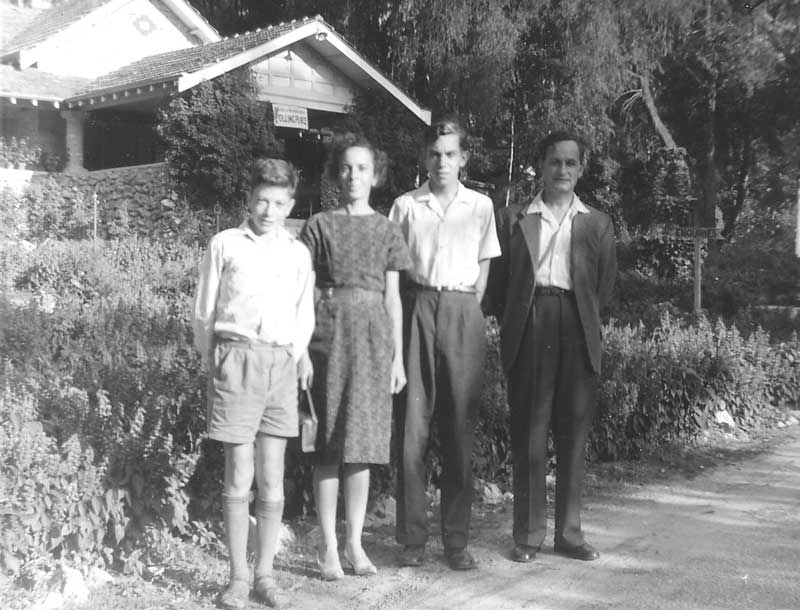
The Yarrow family at Yanchep National Park
We returned to Melbourne from our hioliday in Tasmania at the end of 1961, unaware that within a year's time we would have moved to Perth. Though my brother and I were relatively settled at school and Mum had found a good job with the automotive parts manufacturer Robert Bosch, Dad's employment situation was far from satisfactory. Upon our arrival in Melbourne, he had gone to Kirkstall Repco to take up the job he had been promised only to find that the manager who had invited him to Australia was no longer working with the company and there were no tradesmen's positions available. They took him on as an unskilled labourer but the wage was far less than he was expecting and he started looking for work elsewhere immediately. He found a job not far away but again, it was below his level of skill and he was again being paid well below what he was capable of earning. To make matters worse, the country was going through a credit squeeze and few companies were taking on new staff.
Not long after returning from Launceston, a church minister from England who had settled in Perth visited the church, recognised my father and began talking to him. Seeing the unstablising effect the work situation was having on Dad, he put it to us that a move to Perth may be in order. Both Mum and Dad were interested in the idea, as they had both liked what they saw of Perth on the way through in 1960. After a family discussion, it was agreed that Dad would go to Perth for three months by himself, and if the work situation proved to be better over there than in Melbourne, we would follow later in the year.
In late January 1962, we waved goodbye to Dad who travelled to Perth by train. Within a week of his arrival, he got a job and had felt so welcome in the church over there, he asked us to join him as soon as possible. Mum put the house up for sale and it sold quite quickly. We had bought very little furniture in Melbourne so it was a relatively simple task to sell it and make the journey to Perth. The trip from east to west appeared to afford us the opportunity to see more of Australia on the train, but to our surprise it was cheaper to travel by ship, so we ended up booking our passage on the 7-year old Shaw, Savill & Albion liner, SS Southern Cross. It was a remarkable ship for her time, with significant innovative features.

SS Southern Cross
SS Southern CrossUp until that time, the Southern Cross
had been operating on an around the world service, leaving Southampton
for Australia via South Africa, then continuing east to Los Angeles,
through the Panama Canal and back to Southampton. With the introduction
of Shaw Savill's new liner, Northern Star, to the same service, the
direction in which Southern Cross sailed was reversed. We sailed from
Melbourne to Fremantle on her first voyage travelling from west to
east, arriving a week before Easter on 13th April 1962.
By the time we had to say goodbye to the friends we had made in Melbourne, I was nearly 12 years old and just six months away from starting high school. Though I had agreed with the family's decision to move to Perth, when the time came to do it I realised I didn't really want to leave my familiar surroundings. My attitude towards my school and my fellow students had changed dramatically since that first day when I had made such a fool of myself. Varadi had become a very good friend and young Liesel, though still the cheeky thing she had always been, was at least talking to me now. The two boys who lived over the road from me often invited me to watch their television with them and I had made friends with them also. They didn't want me to go and even cried when it was time for us to leave, which set me off. I recall bawling my eyes out as we dragged our suitcases down the hill to the bus stop.
I didn't enjoy this voyage anywhere near as much as I did the trip to Australia aboard Strathaird, perhaps because I was pulling up roots. It proved to be more of a wrench for me to leave Melbourne than it did for any of the other members of the family because I was the only one to have come close to anyone there. It was a four-day voyage and three of them were through seas equally as choppy as those I had encountered in the Bay of Biscay two years previous. The voyage was so rough, not only was I rarely able to go up on deck, I actually succumbed to seasickness on two occasions. Because of my age, I was allowed in the main dining room instead of being relegated to the children's sittings. The meals were so much better than those served up to the kids on Strathaird, which in hindsight was the journey's one redeeming feature.
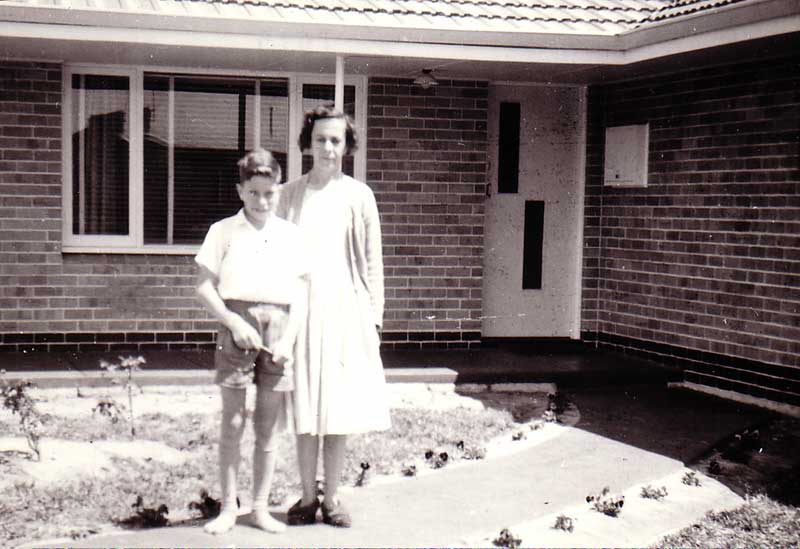
My mother and I outside our new home in Nollamara
Settling Down In PerthUpon our arrival at Fremantle we
were whisked away to our temporary accommodation in Rookwood Street in
the Perth suburb of Mt Lawley. It was the home of a dear old lady at
the church, but because it was a rambling old place and I was missing
my friends, I never felt very safe or comfortable there. I recall
crying myself to sleep on more than one occasion and it was seeing me
so unhappy and unsettled that led my parents to move out into a rented
house immediately rather than working out where we wanted to live and
then buying a home over the next few months as originally planned. We
moved into a rented house in Fourth Avenue, Mt Lawley a few streets
away from the home of a young boy named Greg from the church.
Greg and I got on well together but because the move had had such a
negative effect on me, my parents decided it best that I not be
enrolled into a new school until they had bought a house and we had
moved in. Their logic was that starting two new schools in a six month
period would be too much for me to cope with. My brother, on the other
hand, was eager to start school; as he was in year 10 high school, it
was important he was enrolled and settled as quickly as possible, with
the leaving certificate examination just over two years away. By the
August 1962 school holidays, my parents had bought a new home at 47
Constance Street, Nollamara, and we had moved in. At that time
Nollamara was one of the outer northern suburbs of Perth. At the end of
our street was Nollamara State School, into which I was enrolled; two
streets further on was the local shopping centre and the northern
section of the suburb, and then there was virgin bush.
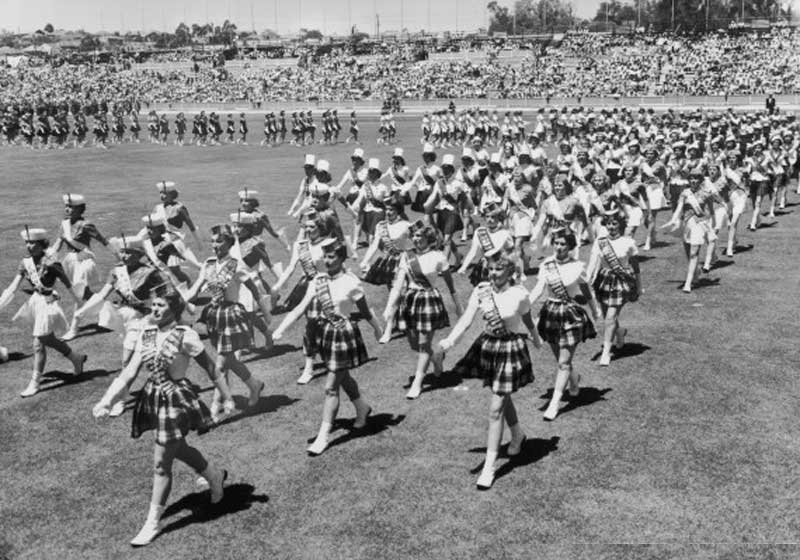
Commonwealth Games opening ceremony
1962 British Empire and Commonwealth GamesOne of the
major contributing factors to becoming settled into life in Perth as
quickly as I did after such a shaky start was the VII British Empire
and Commonwealth Games, which were held in Perth between 22nd November
and 1st December 1962. Though I was never really into sport either as a
spectator or a participant, these games really captured my attention
and interest. In the August school holidays of 1962 a school teacher
from the church took my brother and I around to all the major
Commonwealth Games venues that were either in the finishing stages of
construction or had been completed. We visited Beattie Park Aquatic
Centre, which was ready for the Games but did not open for public
use until after the Games. It was quite a thrill for us to see it as
Dad had made all the aluminium windows for it. It was here that I would
attend the last concert in Australia by the original Seekers before
they broke up in July 1968, and in July 1971 a concert starring The Bee
Gees, Russell Morris and a line-up of other Aussie talent including
Brian Cadd on piano. I always thought it was a strange venue for music
concerts, but it worked. Parking was a disaster, but its three-sided
seating meant that, wherever you were, you were never too far from the
performers who did their thing on a stage suspended over the main pool.
The first Commonwealth Games were the product of discussions and ideas shared over a thirty-year period of time. John Astley Cooper proposed sports and cultural gatherings for English speaking nations in 1891. In 1911 sport competitions were part of the Festival of the Empire in London, England, in which athletes from England, Canada, South Africa and Australasia (Australia and New Zealand combined) took part. At that festival, Australia's Harold Hardwick scored an unusualx double. He not only won the 100 yards freestyle, in a time of 1min and 0.6secs, but he also won the heavyweight boxing title. The first games in Hamilton Ontario, Canada consisted of six sports, with around 400 athletes from 11 nations.
The name of the games has changed frequently. The first four games were known as the British Empire Games. The name was changed to British Empire and Commonwealth Games for the 1954-1962 games. From 1966 to 1974 the name British Commonwealth Games was used and from 1978 to the present they are known as the Commonwealth Games.
Perth had a challenge ahead when its bid for the 1962 Games was accepted. It was a city with a population of less than 500,000 and virtually no sporting facilities of international standard. Within the boundaries of the City an athletic stadium was built (Perry Lakes), a swimming complex (Beatty Park) and cycling velodrome (near Lake Monger). Other sporting events were hosted at existing facilities. A village of 150 homes was built to house the athletes in the suburb of City Beach. The Perth City Council donated the land worth £200,000 on which the village was built. The Games were officially opened by HRH Prince Philip, the Duke of Edinburgh.
The VII Commonwealth Games are remembered for its “heat, dust and glory”. The day before the Perth Games opened the temperature was an expected 28 degree Celcius but the heat was measured at 40.5 degree at the opening ceremony in the new 30,000 capacity Perry Lakes Stadium the following day and such extremes persisted throughout the Games’ duration. In the previous 65 years, only ten Century-plus (100 degree Fahrenheit, 37.8 degree Celcius) November days had been recorded in Perth. At the opening ceremony, Australian soldiers were pressed into action, ferrying water to competing athletes.
James Coote of the London Daily Telegraph described: "The VIIth Commonwealth Games have proved that it is possible for an area as basically devoid of sports interest as Perth to stage the second most important sports meeting in the world - and stage it successfully. Perth has shown that these Games will continue for years to come." Thirty-five countries sent a total of 1,041 athletes and officials to Perth. Jersey was amongst the medal winners for the first time, whilst British Honduras, Dominica, Papua New Guinea and St Lucia all made their inaugural Games appearances. Aden also competed by special invitation. Sabah, Sarawak and Malaya competed for the last time before taking part in 1966 under the Malaysian flag. Nine sports were featured at the Perth Games – athletics, boxing, cycling, fencing, lawn bowls, rowing, swimming and diving, weightlifting and wrestling. A total of 320 medals were awarded, Australia's medal tally was 38 gold, 36 silver and 31 bronze, a total of 105 medals.

Perry Lakes Stadium
The next venue I remember visiting, which was still under construction,
was Perry Lakes Stadium. When we arrived the main arena was a giant
dust bowl as the grass had not yet been laid. Until the Perth
Entertainment Centre was opened in December 1974 and the music
promoters switched venues, Perry Lakes Stadium would host a string of
popular music concerts. It was here that I witnessed my first Peter,
Paul & Mary concert and got to meet the trio backstage for the
first time. I later saw Creedence Clearwater Revival, whose support
band was the Aussie group, Sherbet, and folk singers Joan Baez, John
Denver and Arlo Guthrie in their respective concerts. Perry Lakes
Stadium was also the venue for the gospel crusade of Leighton Ford, the
brother of evangelist Billy Graham, held 22nd-29th March 1968, for
which I volunteered my services as an usher. Today, the venue sits
unused, a white elephant that is under threat of being torn down and
replaced by home units as is the Perth Entertainment Centre, which took
over from Perry Lakes as the venue for all live concerts after its
completion in 1974. It, too, was made obsolete with the opening of the
Burswood Dome in 1988. That, too, is now also scheduled for demolition.
Though by no means in the same league as the Olympic Games, the British Empire and Commonwealth Games as they were known then were and still are an opportunity for many of the world's top sports people to get together and compete, and Perth's Games were no exception. Dawn Fraser, arguably one of the greatest female swimmers in history, won four gold medals in the 110yds freestyle, 440yds freestyle, 4x110yds freestyle relay and the 4x110yds medley relay at those Games. I was fortunate enough to be among the crowd cheering her on to her 440yds freestyle Gold Medal win in the Beattie Park Aquatic Centre pool.
The Games were not held during school holidays but children were given the opportunity to attend events with time off school granted if tickets were produced. My brother sat his Leaving Certificate and left high school in that year, and his end of year exams had been brought forward a month so they did not clash with the Games. My school was among a number of schools chosen to send a contingent of students to take part in a pageant at the Opening Ceremony. Unfortunately for me, those who represented my school, which included about five from my class, had been selected prior to my arrival at the school. I took two days off and attended a variety of events. As well as seeing a number of swimmers in action, I missed Ron Clarke come 2nd in the 3-mile race on the cinder track at Perry Lakes Stadium but saw Betty Cuthbert's gold winning performance in 4x110 yards Relay final. I spent Saturday 24th November 1962 in King's Park, where the 120- mile cycling road race was held. NSW cyclist Frank Brazier was the best of the competing Australians, coming fourth. HRH the Duke of Edinburgh was present to present the medals and I was among a number of children he spoke to before the presentation. Ten years later he visited the Fremantle Museum where I worked and we met again. I reminded him of our meeting a decade earlier in King's Park and I was surprised that he recalled his amusement at being asked by me why his son Charles was not competing in the Games (the answer he gave was that Charles was too young - he was 14 years old at the time).
Though it boasted a population of some half a million people, by comparison to Sydney and Melbourne, Perth in 1962 was very much a big country town where the pace of life was slow and not much had happened until then. That had all begun to change in 1958 when Perth's bid for the 7th British Empire and Commonwealth Games was successful. The city awoke in a flurry of activity, knowing that the 10-day event it had committed to hosting would bring the world, or at least that part of the world attached to Britain and its Commonwealth, to its door. Preparing itself for the biggest influx of tourists it had ever seen, Perth built its first freeway, the Kwinana Freeway, alongside the Swan River's South Perth/Como foreshore and a new bridge across the river (the Narrows Bridge), linking it to the city centre. Its residents were treated to new world-class sporting venues the likes of which had never been constructed there before that catered for swimming, athletics, cycling and boxing.
The 1962 Perth Commonwealth Games had taken so long to prepare for
but came and went in ten short days. But as the last competitor waved
goodbye, Perth was not about to return to being the sleepy, isolated
city it had previously been. The state of Western Australia, of which
Perth was the capital, was already being swept into a period of great
prosperity as its mineral deposits were being discovered and the mining
of them commenced.
In the early 1960s Langley George Hancock recommended that the mining
company Rio Tinto look at several prospects in the Pilbara. An historic
moment in the discovery of one of the world's richest iron ore bodies
came in 1962 just two days after I had stepped off the Southern Cross
in Fremantle when two geologists found a large dark outcrop which
extended about 6.5 kilometres. This, the biggest deposit of high-grade
ore in the Hamersley Ranges, was later to be named Mt Tom Price, in
tribute to an American engineer who was instrumental in the Pilbara's
development. Thomas Moore Price had personally surveyed the Hamersley
Ranges, and promoted the region's iron ore prospects with great
enthusiasm. Despite the extremely limited infrastructure in the remote
Pilbara, it took just 19 months to commission the initial Mount Tom
Price mine infrastructure, build a shipping port at Dampier, a railway
and two support towns. Mining at Mt Tom Price and Mt Goldsworthy
resulted in the first iron ore being exported from WA in 1966. Two
years later, the iron deposits at Mt. Whaleback had been pegged and
mining commenced. Bauxite was discovered and began to be mined in the
Darling Range and Mitchell Plateau while the discovery of nickel at
Kambalda (1966) and Mt Windarra (1969) brought about a Nickel boom. All
this mining activity brought unprecedented wealth, prosperity and
growth to the City of Perth at a level it has not seen before or since
and I was fortunate enough to witness it all firsthand.
Australia in 1962In January, devastating bushfires ravages the towns in the Dandenong Ranges on the outskirts of Melbourne. In March, Sydney's Cahill Expressway across the front of Circular Quay was opened and Australian Aborigines were granted the right to vote in Federal elections for the first time. A month later, the Southern Aurora train began its service between the Australian capitals of Sydney to Melbourne on a Standard Gauge track. For the first time passengers could travel interstate by rail without the need for a change on the state border. Previously, upon arrival at Albury, they had to step out of their train, cross the platform and board another train on a different gauge line, and then continue their journey. In May, Australia entered the Vietnam War conflict by committing to send military advisers to Vietnam. In August, six Australian Air Force pilots were killed in a stunt team crash in Victoria, and alcohol bans were lifted for aborigines in NSW. On 28th September, a fire destroyed one fifth of Brisbane's tram fleet of 67 vehicles.
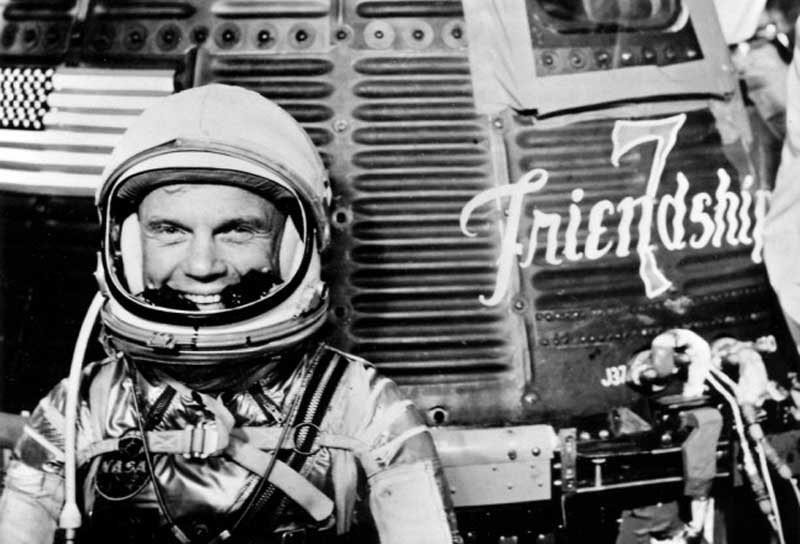
John Glenn, Friendship 7
The World in 1962In January, Pope John XXIII
excommunicated Cuban premier Fidel Castro. On 13th February, John Glenn
became the first American astronaut to orbit the Earth. His voyage in
Friendship 7 was televised by all three US networks and watched by 135
million viewers. During the flight he saw the lights of Perth, Western
Australia, which had been left on overnight for him. He dubbed it the
City of Light, a term the city used to describe itself for many years.
In April, NASA's Ranger rocket crashed on dark side of the Moon and the
Beatles' original bass player Stuart Sutcliffe died in the arms of his
girlfriend Astrid Kirchher in Hamburg, Germany, aged 21 of a brain
haemorrhage. Paul McCartney took his place on the bass guitar and a
month later, drummer Pete Best was sacked and replaced by Ringo Starr,
completing the Beatles' line-up that would bring the band phenomenal
success and fame. They released their first single, Love Me Do, on 5th
October.
In July, an experimental telecommunications satellite developed and owned by AT&T and Bell telecommunications called Telstar was successfully placed in orbit around the Earth. It allowed the transfer of TV pictures across the Atlantic from Maine to Great Britain and France for the first time. Actress Sophia Loren appeared in an Italian court on bigamy charge nine weeks before actress Marilyn Monroe was found dead in her bed in Los Angeles following a suspected drug overdose, on 5th August. An earthquake in Iran left 20,000 people dead. During October, the events of the Cuban Missile Crisis took place in which the US threatened the Soviet Union if it did not withdraw its missiles from Cuba. In November, Nelson Mandela was jailed for five years, former US President Eleanor Roosevelt died and agreement was reached between Britain and France to cooperate on building the world's first supersonic airliner, Concorde. In December, the US space probe Mariner 2 sent back the first close-up pictures of Venus, and President Kennedy agreed to supply Britain with Polaris nuclear missiles.
The most popular songs in 1962 included: Ramblin' Rose (Nat 'King'
Cole); I Remember You (Frank Ifield). This song was the first
Australian record to appear in the US charts. Lovesick Blues (Frank
Ifield); I Can't Stop Loving You (Ray Charles) Roses Are Red (Bobby
Viinton); Sheila (Tommy Roe); If I Didn't Have a Dime (Gene Pitney);
The Man Who Shot Liberty Valance (Gene Pitney); Big Girls Don't Cry
(Four Seasons); Telstar (Tornadoes); He's a Rebel (Crystals); Return to
Sender (Elvis Presley); Sing (Johnny O'Keefe); Limbo Rock (Chubby
Checker)
When the Girl in Your Arms Is the Girl in Your Heart (Cliff Richard);
The Wanderer (Dion); Multiplication (Bobby Darin); I've Been Everywhere
(Lucky Starr); West of the Wall (Toni Fisher); Do You Want to Dance?
(Cliff Richard); Wolverton Mountain (Claude King); Silver Threads and
Golden Needles (Springfields); Working For The Man (Roy Orbison); The
Lonely Bull (Tijuana Brass); The Swiss Maid (Del Shannon); Alley Cat
(Bent Fabric)
The most popular movies in 1962 included: The Birdman of Alcatraz (Burt
Lancaster, Karl Malden); Bye Bye Birdie (Janet Leigh, Dick van Dyke);
55 Days at Peking); Charlton Heston, Ava Gardner); Hatari! (John Wayne,
Elsa Martinelli); How the West Was Won (George Peppard, Debbie
Reynolds) Lawrence of Arabia (Peter O'Toole, Alec Guinness) The Longest
Day (Richard Burton, John Wayne); Mutiny on the Bounty (Marlon Brando,
Trevor Howard); State Fair (Pat Boone, Bobby Darrin, Ann Margret).
Sport in 1962 VFL Grand Final (Melbourne): Essendon (13:12) d Carlton
(8:10) Rugby League Grand Final (Sydney): St George 9 beat Western
Suburbs 6 Tennis: Davis Cup - Australia (5) d. Mexico (0). Margaret
Court was the Australian and US singles champion. "Rocket" Rod Laver
won the Australian singles championship, the US singles championship,
the French singles championship, the Wimbledon singles championship and
the Grand Slam. Cricket: test match series England in Australia,
November 1962 to March 1963 Australia won a test, England won a test (1
drawn) Sheffield Shield 1961-62 season: Winner- NSW. Best batting
average: Graham Bizzell (Qld) Innings: 2. Runs: 135. Highest score 82.
Average: 67.50 Most runs in the season: Bill Lawry (Vic). Innings: 15.
Runs: 790, Highest score: 150* Average: 56.42 Most wickets: Wes Hall
(Qld). Innings: 8. Runs: 203.5. Average: .25. Best figures: 7-76.
1963: My Last Year in Primary SchoolJust as the Commonwealth Games had heralded a major change in the life of the City of Perth, so it heralded a major change in my life and the opening of a new chapter - my 22 years as a Sandgroper (Western Australian). My first year as such was sufficiently uneventful for me to have little recollection today of my four school terms at Nollamara State School. I recall liking the school, as it was set in a picturesque bushland. In 1963 the school won the School of the Year award that was presented by the Education Department of Western Australia to the school with the neatest and cleanest grounds. I remember staying behind after school had finished on many occasions to comb the bush surrounding the school for rubbish and being surprised at how much was found. It was at Nollamara State School that I made my one sporting claim to fame; I broke the school's triple jump record. I like to think it still stands today, but to avoid disappointing myself, I have never bothered to verify this.
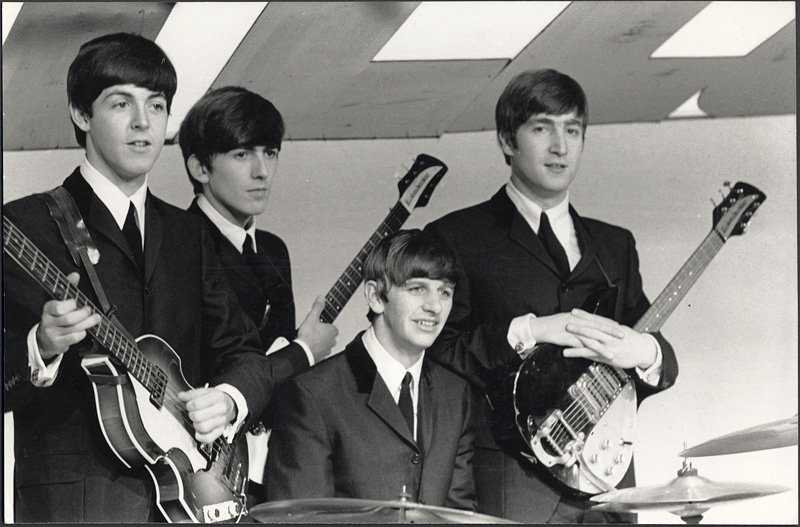
The Beatles
My first day of school in 7th Grade, was a momentous day, but at the
time, my fellow students and I had no idea of the major changes that
events occurring on the other side of the world were about to bring
into our lives. It was 11th Feburary 1963, which history records as the
day that the so-called Swinging Sixties started swinging. On that day
The Beatles entered EMI's Abbey Road Studios in London with producer
George Martin to begin recording Please Please Me, their first album
for Parlophone. It would not only rocket them to international fame and
turn the world of popular music on its ear, but also kick-start an era
of change in a decade that would become permeated by sunny optimism.
The introduction of the contraceptive pill in the same month would
bring a new freedom for women. It would also help bring a
'permissiveness' to the Western world's youth as they rebelled against
the conformity of the fifties.
Youth culture would take the lead exactly as the decade's Pied Piper
and inspirational figurehead, Bob Dylan, predicted it would in his
song, "The Times They Are A'changin". To help it along, a year later
recorded music would become portable for the first time with the
invention of the audiocassette, and the world's first discotheque,
Whisky a-go-go, would open in Los Angeles. As the decade progressed,
Twiggy and Jean Shrimpton would model the latest mini skirts and
innovative hairstyles of Vidal Sassoon. Boutiques and discotheques
would become the chic places to go. Employment would be high, allowing
consumerism to flourish and motoring to become a pleasure affordable to
most. America would win the Space race and land a man on the moon in
July 1969, the crowning achievement in a decade of spectacular
technological advancement.
High School: 1964 to 1968At the end of 1963, my days in primary school were over and I began to prepare for my five years in High School. Those five years were very much a mixed bag for me - in some ways they were the most enjoyable, but the strict code of conduct placed upon me by my parents alienated me from the rest of the student body that I would never really became a part of. I felt very much the odd one out, the round peg in the square hole, and a shadow of isolation and loneliness hovered above me throughout what could have been and should have been the best five years of my life. The school I was allocated to attend was Tuart Hill Senior High School. When I commenced my studies there, the school had been open for just four years. Starting with just 1st year students (Year 8) in 1960, each year saw a new batch of first years added until my year, 1964, which was the first year in which all years (1st to 5th year) were represented in the student body. It was very much a Baby Boomer's high school, having been built to cater for the first batch of Boomers in Perth's northern suburbs and would later be converted to a tertiary college as their numbers began to dwindle. From what I am led to believe, the school's student numbers peaked in my fifth year (1968) and from that time until the school's closure in 1981, they fell into gradual decline. The complex was refurbished in 1982 and reopened as Tuart College, offering tertiary education specifically geared towards overseas students.
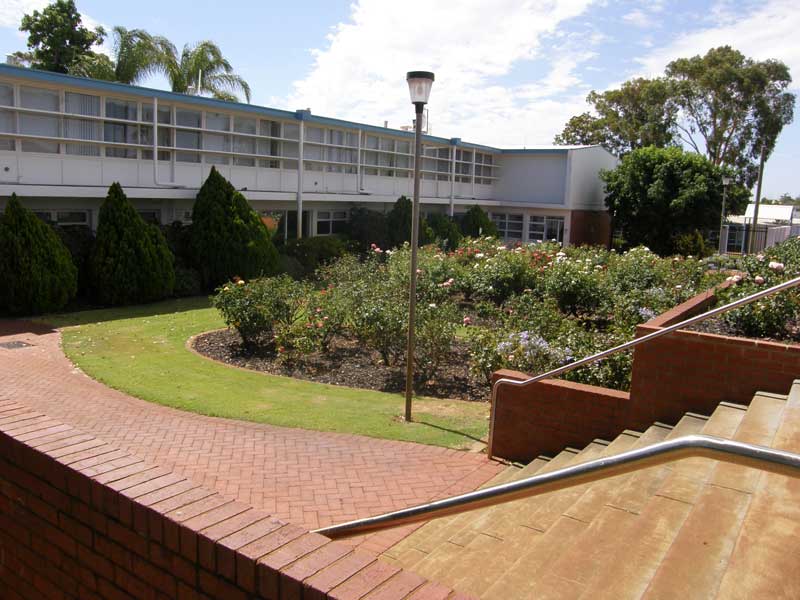
Tuart Hill Senior High School
Tuart Hill Senior High SchoolIn February 1964 when I
started school there, Tuart Hill was one of Perth's most northerly
suburbs. To its north along Wanneroo Road were Balcatta and Nollamara
where I lived, after which you were pretty well out in the bush.
Balcatta and its neighbours Osborne Park and Gwelup were mainly market
gardens operated by Italians and Greeks, and many sons and daughters of
these European migrants became my fellow students. Nollamara, where I
we lived, had been developed after World War II and comprised mainly of
either weatherboard, fibro or brick veneer state houses. Most of the
students came from Tuart Hill, Yokine and Joondanna with a few from
Karrinyup and the beachside localities of North Beach and Waterman. The
population in these areas was quite sparse; there was no high school
there so students from these areas were sent to Tuart Hill. They were
picked up by a bus that travelled the length of North Bead Road.
For me at Tuart Hill High School, it meant an introduction to a world
that, thus far, had been totally unfamiliar to me. I had lived in a
very sheltered and far stricter religious environment than most where a
lot of things were out of bounds. It doesn't affect you very much when
you are a child, but as you grow older you become much more aware of
the world around you and of the restrictions placed on you. I found
myself in a world that felt quite claustrophobic. In the early 1960s,
young people followed the pattern set by their parents without
question. If they were Catholics, you were Catholic. If they didn't
smoke, you didn't smoke. There was a healthy respect throughout the
community of one's elders. Their decision was always final and was
never questioned except by the
most rebellious. For me, the notion of questioning authority never
entered my head until second year high school when a teacher spoke
about not believing everything you hear, but to question everything and
then make up your own mind. Though he was speaking in relation to how
the truth in science has been found by the questioning of commonly held
beliefs based on theory, what he said got me thinking about authority
in general and sowed the first seeds of doubt about whether or not my
belief structures were soundly based.
I learnt a lot in my first year of high school. For starters, I
discovered that I wasn't quite as smart as I thought I was and that
intelligence and ability had nothing to do with whether or not I was
born in Britain. In my last year in primary school, I did very well in
my grades, coming third in a class of 25 children, and was very much a
big fish in a little pond. At High School I was placed in a 'profession
level' class geared towards the more academically minded student and
suddenly I was a little fish in a big pond. Of the 100 or so kids in
the professional classes, I was ranked about 80th at the end of first
year. It was a huge disappointment to me and a shock to my system, made
worse by my mother reminding me that my older brother had just
graduated from high school with flying colours and was now working in
an office and studying to become a chartered accountant.
Early on in First Year I began to see in myself the beginnings of what
I later recognised as being a creative side as I began developing a
love for writing, drawing and designing things. I began taking an
interest in automobile design and would often watch the cars on the
road passing by as I cycled to and from school. Every time I'd see one
that I didn't recognize I'd go home and draw it from memory and then
watch out for it again another day to see how well I had remembered the
details of its shape. I even sent samples of my designs to major
international motor manufacturers. I never received any feedback but on
two occasions saw a grille and a tail light cluster shape that looked
remarkably like ones I had drawn and sent them a year or so earlier.
The egg-crate grill on Lamborghini's Espada is remarkably like the
grille on the front of a design I sent them two years before the car
was released.
By the end of my first year of high school I had become a full
bottle on the world of popular music, such as it was when 1965 was
being ushered in. The Beatles were huge, it seemed everyone was talking
about them, everyone at school was buying their records; everyone, that
is, but me. I was told that the music they played was jazz and jazz was
evil. It had rhythms and drum beats that originated from the
witchdoctors in deepest Africa and by listening to it, the evil spirits
that had inspired these rhythms would enter my mind and corrupt it. I
kept being drawn into conversation at school about the latest hit songs
and the latest group to come out of Liverpool and have a hit record but
couldn't join in because I never heard the songs they were talking
about. I was left with no choice but to withdraw myself from the others
so that I didn't have to show my ignorance. As a result I became
somewhat of a recluse. I kept my distance from everyone and had no
friends until the middle of Second Year when a First Year boy called
Terry attached himself to me.
At first I thought he hung around me because he liked me but I soon
realized it was because he and my father had a joint interest in
building radio sets. Every time he'd come around to my house, he'd say
hello to me upon arrival and then head straight for the garage where my
father was building a radio. I wouldn't see him again until it was time
for him to go home, when he would pop his head around the door, say
goodbye, and head home. The one upside to this lop-sided friendship was
that Terry gave me the first radio he made as a Christmas present at
the end of First Year. After twiddling the dial I found a station that
played the music everyone at school was talking about and I began
listening to it. I was able to do this at night without my parents ever
finding out as my bedroom was at the back of the house away from the
others at the front. After everyone had gone to bed, I'd make sure the
coast was clear and then I'd turn the radio on. At first I felt like a
naughty boy who was getting up to something bad while his parents
weren't looking but as I began to listen to the lyrics of the 'boy
meets girl, falls in love' theme of most of the
songs, I started to question what was so devilish about them.
Furthermore, I found I related to the feelings expressed in those songs
because during first year high school, like most boys, I had begun to
discover girls. I liked what I saw, however I had no idea how to
communicate with these mystical creatures called girls or how to react
to them.
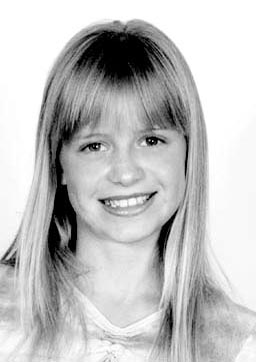
Melanie ... My Shadow
Me And My ShadowUpon commencement of third term first
year high school in August 1964, what to do with the feelings I began
feeling was something about which I didn't have a clue and wouldn't
have for a considerable number of years. At that time, sex education
was not taught in schools - the attitude was very much in the Monty
Python vein of 'Nudge nudge, wink wink, say no more; you know what I
mean?' I could nudge, I could even wink and saying no more came as
second nature to me, but the trouble was, I didn't know 'what you mean'
and it seemed no one was going to tell me either. The closest I got to
a discussion about the birds and the bees was when I spoke to a man at
church about such matters and he told me about some horrible 'thing'
inside all men that raises its ugly head when girls are around. Fed by
that sinful jazz music I had been warned not to listen to, this 'thing'
would kick in whenever I was near girls and if I didn't withdraw myself
and take myself into check immediately, it would take over my mind and
I would do awful things to girls that I would regret for the rest of my
life.
I was pretty sure I had experienced what he was talking about because
what prompted me to have this conversation in the first place was a
funny feeling I had just experienced on the bus travelling to and from
the school's sports carnival a few days earlier. Not only did I have to
stand throughout the journey to the carnival and back, I had to stand
next to girls. Being closer than arm’s length to
girls was a totally new experience for me and felt about as scary as
standing next to a pit bull terrier. On the way to the carnival we were
packed in like sardines and I found myself pushed up against a pretty
little blonde girl. My hand was down by my side and quite by accident
ended up in the vicinity of her bottom. She must have felt my hand
because she turned to me, let out a chuckle and said, 'naughty,
naughty'. Though I couldn't see it, I am sure my face went bright red
but there was no escape. The bus was full and I had to look at her and
her cheekily grinning at me all the way to the carnival.
After we arrived, I noticed she had positioned herself on a grassy bank where she could get a good view of me. I found myself looking in her direction too however I quickly turned away every time she looked my way. I didn't want her to think I knew she was there, not to mention the fact that I was eyeing her up and down too. I so much wanted to go over and talk to her but my communication skills with girls were none existent as I had no sisters and had deliberately kept a safe distance from all the girls at church. Midway through the carnival she got up and walked towards me. I was so petrified I jumped to my feet and told her I had to go to the toilet and took off. The boys toilets were just off to the side of a flight of steps which led up to the top of the grandstand. There was a huge congregation of boys in the toilets and I wondered what the attraction was. I found out when I went in and saw them all looking up the skirts of the girls as they walked up and down the grandstand stairs above them. I took a quick peak to see what all the fuss was about but didn't quite know what it was I was supposed to be looking at or sniggering about so I decided to go back to my seat.
Like a little shadow, the blonde girl had followed me and was now standing outside waiting for me. I was given no choice but to walk back and sit with her for the remaining hour of the carnival. She proceeded to tell me her name was Melanie but not before apologizing for embarrassing me on the bus. She promised never to do that to me again then told me all about herself and her family. I was hooked. Unfortunately, the best I could do to keep the conversation going was to ask her what it was like being named after a pumpkin. She looked at me very seriously and said, 'melons aren't pumpkins', then gave a chuckle. She told me I was cute, then asked me about myself so I told her my name and that she wouldn't like my family as they were boring. On the way back to school Melanie made sure we were on the same bus together. She stood next to me again and positioned herself in a way that our hands dangling by our sides were in close proximity to each other. A couple of times she took my hand and I tried very hard not to react. Every time the bus went around a corner, she lost her balance and always managed to lurch in my direction. After each lurch she let out another chuckle.
As the man from church talked to me, everything he said seemed to describe how I had felt during my brief encounter with Melanie, and therefore I took every word as gospel. I hadn't a clue what this 'thing' was that he was talking about - he didn't volunteer more information and I wasn't game enough to ask. I didn't have the slightest idea what terrible things it was going to make me do if I didn't keep it in check, but I wasn't about to allow myself the opportunity to find out. But then I started to panic when he told me about how this 'thing' also gets into girls, especially those who aren't Christians, and causes them to lure boys to their destruction by seducing them. I was convinced that's why Melanie had behaved the way she had towards me and that her being squashed up against me on the bus was a deliberate act of seduction on her part. If someone had said she had packed the bus full of students as part of her plan to bring me down, I would have believed them. I decided there and then to have nothing more to do with her ever again. Not only that, I'd rather not have anything to do with any girls ever again, except perhaps for Christian girls, and only then after they had proved to me that they didn't have any evil desires or feelings towards me. I didn't realize how much of a recipe for disaster this master plan was, or how much damage it would do.
Back at school I managed to avoid Melanie for a few weeks by looking out Terry and spending my free time with him. He was a bit of a loner like me and we ended up walking round and around the main quadrangle during lunch and recess breaks for the next two years. We talked – no, Terry talked none stop about anything and everything, but usually about nothing in particular, and I avoided eye contact with everyone around us. This worked fine for a little while, but Melanie was quite determined to continue what she had started and soon worked out which room was my form room. We had roll call there every Monday, Wednesday and Friday morning and she must have risked getting into trouble by avoiding her own roll call so that she could be outside my form room one morning as the class filed in. I'd just had a birthday and somehow she had found out because she gave me a birthday card. Everyone in the classroom went 'Ooooo, Spaz has got a girlfriend' and I slid into my seat, wishing a hole would open up and swallow me.
I managed to avoid Melanie for a few more weeks by coming either
very early or very late to roll call. Not to be deterred, she
re-appeared one afternoon and asked me if I would take her to the
forthcoming school social. I told her I'd have to ask my parents, which
she seemed to cope with. I went home and asked, but was given the
rundown on what sinful things a simple dance could lead to and that I
should have known better not to have even asked in the first place. I
was feeling quite torn because part of me really wanted to go whilst
another part was warning me of the dangers. Back at school, I tried the
'avoid Melanie at all costs' routine but there was no way she was going
to let the matter drop. She borrowed a friend's bike after school and
chased after me on it, running me off the road into a clump of bushes.
She apologized profusely as she gave me a 'kiss of life' before
dragging me out of the bushes, checking me over to see that I hadn't
sustained any permanent injury before asking me about the social again.
I didn't have the heart to tell her the real reason so I told her that
our family had something on that night and therefore I was not
available. Feeling guilty for having disappointed her, I made an effort
to be friendly towards her during the remaining weeks of school. We
chatted about a multiplicity of subjects, from her love of painting to
my faith in God. I used to call her my little shadow because she seemed
to be always there, wherever I was, and she quite liked that. She was
particularly curious as to why I believed in God as her father was an
atheist. I gladly shared with her many aspects of my faith and she
listened intently to everything I said. We shared our lunchtimes for a
period of about a month, and I look back now upon them and realise they
were the happiest of my days at Tuart Hill High.
On the last day of school in 1964 she gave me a Christmas card. Unbeknown to me she had arranged for one of the girls in my class to hang a sprig of mistletoe up above the doorway of my form room. As I took her card, she caught me off guard and took the opportunity of giving me a kiss under the mistletoe. Again, my classmates responded with a round of cheers, Oos and Ahs. I found Melanie waiting for me at the bike racks after school. She had again borrowed a friend's bike and asked me if she could ride home with me and I reluctantly said yes. She questioned my reluctance so I told her that my parents did not want me going out with her because she wasn't of 'our kind'. I could tell she was very disappointed and realize in hindsight she would have been more than a little hurt, especially when we got to within sight of my home and I told her that it was best if she just went home. I waited until she had turned the corner before heading home myself, believing she didn't know where I lived and that this action would keep it that way. During the school holidays she came around once when I was out. She was told I wasn't home and that I didn't want to see her, even though I had only gone up to the shop and was due home any minute and was hanging out for her smile. When I returned, I was given the third degree about how I was too young to have a girlfriend and I was to tell her not to come around to the house again.
≈ Australia in 1964In 1964, oil was discovered in Bass Strait, Australia sent a team to the Tokyo Olympics in October, and the yo-yo had replaced the hula-hoop as the latest craze. Yo-yos were first sold in 1929, but had come into its own during the 1950s when the plastic yo-yo was introduced, broadening the number of tricks that could be perfomed. The biggest yo-yo boom in history (until 1995) hit in 1962, following the innovative use of TV advertising. By the end of 1964, the yo-yo's popularity began to wane with the arrival of skateboards. On 10th February, the Australian navy flagship HMAS Melbourne sliced HMAS Voyager in half off Jervis Bay, NSW, an accident in which 82 died. That week, Sydney introduced double decker carriages on its suburban rail services. On 12th June, the Macquarie University at North Ryde, Sydney, was opened, the day before Beatlemania hit Australia with their arrival in Sydney for a worldwind tour. News Limited launched The Australian, the first national daily newspaper, in Canberra on 15th July. In September, Richard Walsh, Richard Neville and Martin Sharp were sentenced to prison after Sydney magistrate ruled Oz magazine, which they published, was obscene. On 2nd October, Sydney's Gladesville Bridge was opened. It was the world's largest single concrete arch. Australian Prime Minister Menzies reintroduced conscription early in November and a few weeks later, La Trobe University was opened.
On 1st August, Melbourne's third commercial TV station, ATV0, was opened by Ansett Transport Industries. At the end of October, HSV7 screened the first episode of a new Melbourne-produced police drama Homicide. It becomes a huge success and ran on the Seven Network for 500 episodes over 12 years. New TV stations AMV4 Albury and RVN2 Wagga Wagga were opened in 1964. The popular music charts of 1964 were dominated by recordings of artists from Liverpool. Led by The Beatles who by now were enjoy success to a level that rivalled that experienced by Elvis Presley a few years earlier, a plethora of artists from the northern England city released hit after hit that were snapped up by an eager audience of teenagers across the world. The arrival of rock'n'roll in the late 1950s brought a major changes to the social art of dancing. Although contact dancing with a partner was still as popular as ever, variations and speed became more frantic and less formalised. Non-contact dances and those that could be performed solo became ever more popular, particularly among the British youth sub-culture, the Mods. The styles and crazes changed with rapid regularity, in line with new records and the changes in musical styles and taste.
The biggest and most enduring of these new dances was The Twist, pioneered in the US by Chubby Checker and a group called Joey Dee and the Starliters, where it was huge, to the point where national competitions were held. It found its way to Australian dancehalls around 1961 with the Chubby Checker record 'Let's Twist Again' and its follow-ups. Instructions for doing the Twist were enclosed with every record sold, advising "Imagine you are stubbing out a cigarette with both feet whilst drying your back with a towel", which pretty well describes it. The Twist was just one of literally hundreds of dance crazes that swept the world in the 1960s and the only one to eclipse it in Australia was the Stomp. The Australian music scene in 1964 was dominated by the Stomp, Australia’s own dance craze that had originated at beach parties on Sydney's Maroubra beach a year earlier. The greatest stomp exponent of them all was Australian singer Little Patti (Patti Thompson), then a 14 year old teenager, who recalls it as an easy dance. "It was two beats to each foot, with a little bit of movement and an intense look on one's face, hands behind the back, head down slightly. Also, you could do it anywhere you liked. There was a particular beat and a particular feel that was typically the Stomp. Of course my records at the time were all about the Stomp, and a boy called Johnny (I don't know who Johnny was)." Along with the Stomp came the surfing lifestyle that is still with us today.
The World in 1964 In February, The Beatles received a rapturous
reception on their first visit to New York and appeared on the Ed
Sullivan Show a day later. A world tour followed, which included
Australia, establishing them as the most popular recording act in the
country bar none. Boxer Cassius Clay became heavyweight champion of the
world, defeating the legendary Sonny Liston, and changed his name to
Mohammed Ali. In
March, Prince Edward and American singer Tracy Chapman were born and
two months later Lenny Kravitz was born. Jack Ruby, the killer of Lee
Harvey Oswald (the man accused of assassinating John F Kennedy), was
found guilty of murder. The youth culture groups of Britain, the Mods
and Rockers, continued their violent clashes on the beaches of Britain.
and India's Prime Minister and statesman since 1947, Jawaharlal
'Pandit' Nehru, died. A month later, Nelson Mandela was sentenced to
life imprisonment for treason, sabotage, violent conspiracy and
plotting to overthrow the South African government. On 2nd August, US
Navy ships were attacked off the Vietnam coast by North Vietnamese
patrol boats. The attack (later revealed to have been provoked by the
US Navy) caused Congress to pass the Tonkin Bay Resolution, enabling
President Johnson to take extensive military action in Southeast Asia.
Lyndon B Johnson won the American presidential elections in November,
defeating Senator Goldwater packing. Entertainers Jim Reeves, Harpo
Marx, Cole Porter and Sam Cooke all died in 1964.
The most popular songs of 1964 included: Anyone Who Had a Heart (Cilla
Black); Always Something There to Remind Me (Sandie Shaw); Mecca (Gene
Pitney); Oh! Pretty Woman (Roy Orbison); I Get Around (Beach Boys); My
Guy (Mary Wells); Where Did Our Love Go? (Supremes); Baby Love
(Supremes); Royal Telephone (Jimmy Little); When You Walk in the Room
(Searchers); I Saw Her Standing There (The Beatles); I Want To Hold
your Hand (The Beatles); All My Loving (Beatles); A Hard Days Night
(Beatles); Don't You Know Yockomo (Dinah Lee); It's All Over Now
(Rolling Stones); Do Wah Diddy Diddy (Manfred Mann); Poison Ivy (Billy
Thorpe); My Boy Lollypop (Millie); She's a Mod (Ray Columbus & the
Invaders); House of the Rising Sun (The Animals); World Without Love
(Peter and Gordon); 4,003,221 Tears From Now (Judy Stone); She wears My
Ring (Johnny O'Keefe).
The most popular movies of 1964 included: A Fistful of Dollars (Clint
Eastwood); Goldfinger (Sean Connery, Honor Blackman); A Hard Days Night
(The Beatles); Mary Poppins (Julie Andrews, Dick van Dyke); My Fair
Lady (Rex Harrison, Audrey Hepburn); Robin & the Seven Hoods (Frank
Sinatra, Dean Martin); Zorba the Greek (Anthony Quinn, Alan Bates).
Sport in 1964 VFL Grand Final (Melbourne): Melbourne (8:16) d
Collingwood (8:12) Rugby League Grand Final (Sydney): St George 11 beat
Balmain 6 Tennis: Margaret Court was Australian singles champion. Davis
Cup: Australia (3) d. United States (2). Federation Cup: Australia (2)
d. United States (1). Cricket: Test matches - South Africa in
Australia, December 1963 to February 1964 Australia won 1, South Africa
won 1 (3 drawn); Australia in England, June 1964 to August 1964
Australia won 1, England won 0 (4 drawn); Australia in India, October
1964 Australia won 1, India won 1 (1 drawn); Australia in Pakistan,
October 1964 1 drawn; Pakistan in Australia, December 1964 1 dawn
Sheffield Shield 1963-64 season: Winner- South Australia. Best batting
average: Peter Burge (Qld). Innings: 55. Runs scored: 685, Highest
score; 283. Average: 171.25 Most runs in the season: Garfield Sobers
(SA). Innings: 13. Runs scored: 973. Highest score: 195. Average; 74.84
Most wickets: Garfield Sobers (SA). Overs bowled: 379.2. Runs scored:
1297. Wickets taken; 47. Average: 27.59. Best score; 6-71 Tokyo
Olympics: 5,151 athletes (678 women, 4,473 men) from 93 nations met in
Tokyo for the XVIII Olympic Games, which were held from 19th to 24th
October. Australia won 6 gold, 2 silver & 10 bronze medals. The
gold medal winners were Betty Cuthbert - 400m; Robert Windle - 1,500m
freestyle; Ian O'Brien - 200m breaststroker; Kevin Berry - 200m
butterfly; Dawn Fraser - 100m freestyle; 5.5m Yachting Team (William
Northam, Peter Donnell, James Sargeant)
1965: Second Year High SchoolWhen school resumed at the end of January 1965, Melanie began avoiding me and, not knowing what she had been told, I assumed it was because she didn't like me any more. I knew why I wasn't supposed to be seeing her and in a way I had accepted it, but in another way I hadn't. She was always very polite to me, very sweet and caring and I couldn't see what was wrong with me talking to her, especially since many of my classmates had girlfriends and boyfriends and nothing bad seemed to be happening to any of them. Besides, I had feelings towards her, too. During those lunchtimes I had spent with her she had been fun to be with and I couldn't figure out what was wrong with being her friend.
I went back to the man at church who had spoken to me about this 'thing' that I had inside me and poured out my heart to him, expecting him to tell me it was fine for me to keep seeing Melanie. Instead he suggested I forget about Melanie and pray that God would send someone 'safer' for me to be friends with from the church. A young girl called Jenny, the daughter of a family that had just migrated from England, seemed to the bill perectly.
I went home from my little chat with the man at church convinced that Jenny was the answer to my prayer. The old notion that Britons were superior to the rest kicked in and I tried to convince myself that, as she was English, Jenny would be far better for me, unlike Melanie who was born in Australia. Furthermore, Jenny went to church, therefore she wasn't going to lead me astray. What more could I want and ask for? I tried to re- channel all the feelings I had for Melanie towards Jenny but I wasn't mature enough to realize that, not only was Jenny just a nine year old girl, but also that any thoughts of romance on my part were totally inappropriate. Fortunately, I hadn't a clue how to express myself, so any expression of how I thought I was feeling that I might have made were so veiled, they went right over her head.
A week after making my momentous decision to take Jenny under my
wing, I was listening to Casey Kasem's Top 40 on my radio in my bedroom
one Sunday night when I heard a new song, the lyrics of which stopped
me in my tracks. It was The Searchers singing 'When You Walk In The
Room', penned by Jackie de Shannon. I listened to the line, 'I can feel
a new expression on my face, I can feel a glowing sensation taking
place, I can hear the guitar play lovely tunes, Every time that you
walk in the room' and I wondered how the songwriter could have known
how I was feeling. If I was to take up pen and paper and write down how
I felt every time I saw Melanie, I couldn't put it any better than
this. 'Maybe it's a dream come true, Walking right alongside of you,
Wish I could tell you how much I care, But I only have the nerve to
stare ...' Jenny or no Jenny, those feelings were towards Melanie and
they weren't about to go away. That night was the first time I ever
cried over a girl. I remember pouring out my heart to God in a prayer
and asking him what was so wrong with being friends with Melanie. The
answer, 'nothing' came into my head but I didn't recognize that it
might have been God reassuring me, and that I should take care but
follow my heart and not let fear rob me of a lovely friendship. I
dismissed it as some selfish notion that I had to ignore, and rolling
over, I cried myself to sleep.
The song I had heard for the first time that night became and still is
one of my all-time favourites. Whenever I play it I still think of
Melanie and the friendship that might have been had I followed my
heart. As it did in Britain, the song went to number one on the hit
charts in Australia. Every time I heard it, I went through what felt
like my own private little heaven and hell. I so much wanted to see
Melanie but it didn't happen and all I ended up doing was trying in
vain to win Jenny's affections. One day I decided to make a last ditch
effort to tell Melanie how I was feeling and so I cornered her after
school and told her we needed to talk. She gave me a look of sadness
that I'll never forget, she then squeezed my hand and said she had to
go, otherwise she would miss her bus. Unsure what to do, I decided to
lay low, ever believing that one day soon things would change and the
opportunity would arise for me to ask her to at least sit and have
lunch with me at school again. A number of months passed and on the
last day of term before the August 1964 school holidays, I thought my
opportunity had come. Melanie made a B-line for me as I came out of
class at the end of the day, but before I
could say a word, she pushed an envelope into my hand, and with tears
streaming down her face, she gave me a kiss and said, 'I love you so
much' before running off towards the bus that would take her home. I
quickly moved away from the school buildings and opened the envelope.
It had a birthday card inside it, upon which she had written, 'Goodbye
my lovely friend. You will always be special to me'. I could barely
ride my bike home as I fought back the tears.
All through the holidays I thought about her, wondering why she
would be saying goodbye to me when I wasn't going anywhere. Deep down I
always believed we'd end up together, and so goodbye was not a word I
wanted to be hearing. During the school holidays I finally plucked up
the courage to call her and used a public phone at the shopping centre
to ring her. With my heart in my mouth I dialled the number but the
phone just rang out. I made three more attempts to ring her later that
week but each time I stopped at the last digit of her phone number,
hung up, recovered my sixpence and walked away. I couldn't take another
rejection.
On the first day back at school I made a desperate attempt to find
Melanie. For three days I looked everywhere; I even skipped my last
class on the third day back so I could be at the stop when she caught
her bus. I waited until the last student boarded and the bus drove away
but she never showed up. The next day, I went to Janet (her real name
has not been used to protect her anonymity), the girl in my class who
had helped Melanie string up the mistletoe, and asked her if she knew
Melanie, and if so, why was she avoiding me? Janet told me that Melanie
had found it so hard to be at the same school with someone she cared
about but who didn't have the same feelings for her, she had asked her
parents to move her to another school. I explained the whole sad
situation to Janet but I wasn’t sure if she really
understood. I asked her to tell Melanie what I had said and she said
she would but I heard nothing more from her.
I don't quite know why, but I went home determined to make another effort to win Jenny’s affections. Whether she twigged to what I was doing or not, I don’t know, but Jenny always managed to keep me at arm’s length though we have remained good friends. The band that would be playing at that year’s end of year school social was invited to come to the school and perform a song or two to promote the function. As if to add insult to injury, the first number they played was 'When You Walk In The Room'. For the rest of the year, I continued to walk round and round the quadrangle with Terry, happy for him to babble on about whatever came into his head so I could get my mind off Melanie.
16 years later and happily married, I was invited to meet the manager of a company that my business had begun purchasing supplies from. I found I really clicked with her and we chatted for what seemed like forever about our respective businesses and the state of the industry in which we were involved. As I made motions towards leaving, she seemed reluctant to let me go and asked if we could continue our conversation over lunch on another day. I agreed and we had lunch two days later. Before I could start talking business, she began opening up about herself, which I found a rather odd thing for her to be doing. She told me that there had been a boy at school who meant a lot to her and then asked me if I knew the song, 'hen You Walk In The Room'. She explained to me how well it summed up how she felt every time she saw this boy. Surprised that this was my favourite song and for the same reason, I told her I loved it too. She then looked away, hesitated and said, 'I know you do'.
I was puzzled by what she was saying and disturbed by the direction our conversation was taking. 'How do you know?' I asked. 'A mutual friend called Janet told me,' she said, looking back towards me and fighting back tears. I suddenly recognized the smile and knew why, when I had first met her, the look in her eyes had seemed so inexplicably familiar. We both jumped to our feet and I gave Melanie the biggest hug I could muster. 'You will always be special to me. I told you that, remember?' she whispered. I tried to say 'yes, I remember' but I couldn't get the words out.
After a quiet moment just standing there, Melanie said she needed to re-compose herself and headed towards the ladies room. When she returned she said something that she had been carefully rehearsing for the past few days. 'We had a friendship back then that was so special, but we've both moved on, haven't we? I'm happily married and you're happily married. The reason I know you are happy is that, because you worked with Janet for a number of years since leaving school, I have been able to follow you from a distance ever since I left Tuart Hill High'.
'You always were my shadow,' I interjected, nervously. She smiled
and then continued. 'I needed to know you were going to be all right. I
was very angry at first, and to get over how I was feeling at not being
able to see you, I used to tell God it wasn't fair. Me, the atheist
talking to God. Look what you did to me! But then I remembered how you
told me that God's love is so strong, He expresses it by giving us what
is best for us. I knew I couldn't be with you so I figured the only way
I would be able to express how I felt towards you was in the same way -
by wanting what was best for you. So that's what I used to ask God for.
'You don't know it but I was at your wedding with Janet and when I saw
you so happy, it hit me that God had actually answered my prayers. It's
funny but seeing you there was like closing that chapter of my life,
except I didn't have to tear the page out like I would have had to do
had I still been hurting. Can you understand why it was so important
for me to share this with you today, to thank you for being part of a
very special moment in my life and to make sure you haven't forgotten
that you will always be special to me?' Again I was lost for words and
nodded at the realization that my original assessment of her was spot
on. She was indeed a very special person.
A short time later, my work took me to Sydney and I moved there with my wife and family. My contact with Melanie these days is quite irregular, as we have little in common beyond a small chapter in our lives. But whenever we talk to each other on the phone, she always ends the conversation by saying, 'You will always be special to me, remember?' to which I always reply, 'ditto, my little shadow'. She then lets out that chuckle I used to adore hearing, and hangs up, and I dig out my Searchers CD and play our song.
en had I been able to have that reconciliatory conversation with Melanie 16 years earlier. Such was not to be and I started 3rd year high school in 1966 feeling rejected, quite isolated and with my ability to communicate with the female half of the people around me in tatters. Four weeks into the first school term of the year, another event occurred that I saw for years as being my just desserts for treating Melanie the way I did.
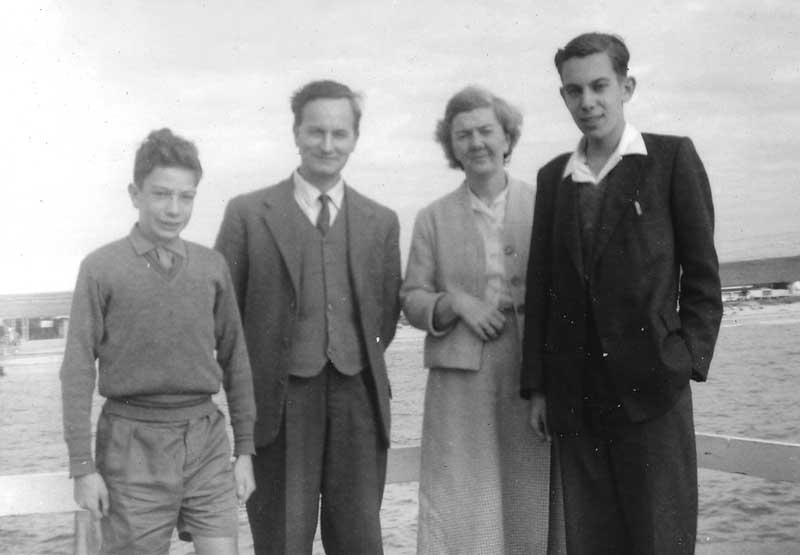
Myself, my father, my Aunt Doris and brother John just before our car accident
After lunch on Saturday 5th March 1966 of a long weekend, our family
decided to take a trip to the beach. We bundled ourselves into our
recently acquired Austin A60 and headed off along Wanneroo Road. As we
passed a row of shops, a car that had been travelling in the opposite
direction to us and was now waiting for us to pass before turning right
accelerated too early, and drove straight into the rear door of our
car. Our vehicle rolled twice before landing on its wheels in the
shop's car park. My father and brother were in the front seats and
sustained no injuries. My aunt, who was sat next to the door that had
been hit, died instantly through internal injuries. My mother was in
the middle of the rear seat and suffered shock, cuts and bruises. I had
been sat next to her. During the car's first roll, the door I was
sitting next to burst open, and I was thrown through the opening and
landed across the curb on my back.
An ambulance was called and my mother and I were taken to Royal Perth Hospital, though I have only faint recollections of the journey. I remember hearing the ambulance siren turning on and off, and then the next thing I remember was the excruciating pain as a doctor sewed my right upper lip back together. Apparently they thought I was unconscious and didn't bother using an anaesthetic. I lost the next three days and came to gradually during my fourth day in hospital. I had apparently suffered concussion, my face was badly lacerated, I had broken two ribs and a collarbone and, according to early X- rays, had fractured my skull. As I came around, I discovered I couldn't move or speak. All kinds of thoughts began to go through my head. 'If this is what happens when you are a Christian, then what's the point? I've lost my little shadow and now this'. I began to wonder what difference does it really make what you believe, just as long as you believe something. And as for God, my thoughts went down the path of 'well, this wasn't a very nice way to reward me for not giving in to that 'thing' that was supposed to be inside me. I don't think he cares one way or the other what I do, if indeed he even exists at all'. My next recollection is of waking up with a gaggle of medicos arguing at the end of my bed. I tried to tell them to shut up as my head was throbbing with pain but again, I couldn't move or speak. They had my chart and a couple of X-rays before them and were discussing them in a very heated manner. 'This can't be the same person,' one of them said, holding up the two X-rays. 'This one had a fracture in the skull and this one hasn't. You can't tell me they are both of young Mr Yarrow here.‚ 'But they are, look at the date and time,' a lady said. She then placed one on top of the other over what looked like a vertical light box. 'See, they are identical, they are both young Mr Yarrow, they were taken 24 hours apart. Look, you can even see the fracture on this morning's X-ray only the fracture of the skull has healed.'
At the realisation of what I has hearing, I sat bolt upright in bed and shouted at the top of my voice, 'Can't you see, it's a miracle'. The doctor turned in stunned silence and just looked at me. The one who had said that this can't be the same person said, 'but ...' and then examined the X-rays again. A nurse rushed up to me, settled me back into a reclining position and said, 'isn't it wonderful?' before filing out of the room with the others, who by now were in deep discussion as to what had actually happened. As their voices faded, I realised my headache was gone and for the first time since I had been hospitalised, I actually felt like I wanted to keep living. Then as I lay there, it was as if I heard another voice saying 'Now do you believe in Me?' From that moment on my whole attitude took a different path. During the next few days as I began to regain my strength I decided that I didn't want to be an accountant and follow in my brother's footsteps like everyone around me said I should. I wanted to design things. I loved drawing cars but realised there wasn't much call for car designers in Perth, so maybe I should try something else and become an architect or a draughtsman. I knew one had to be pretty brainy for that and I wasn't sure if I was up to scratch in that department, so I told my self that if that didn't work out, I could always be a graphic designer or be a writer.
When I got home, I told my mother about all these ideas I had in my head about what my career should be. They all got the thumbs down except architecture so I figured that that must be what I should train for. Knowing it was the year in which I would sit for the Junior Certificate, and having already been off school for a month, I pushed to return to school as soon as possible. After three days back at school, the headaches returned and I was forced to take another month off and join my fellow students at the start of second term in May.
Upon my return, I was expecting to be laughed at because I had
sustained a number of scars to my face, but everyone was so kind
towards me. They stopped calling my Spaz, and even one student who used
to whistle and call me like one calls a dog refrained from this rather
childish act. I later found out that my form teacher had told everyone
in my class that their lives would not be worth living if any of them
dared to say anything negative or derogatory to me. When I began
walking around the school with Terry again, everyone looked at me, but
no one said a word. Terry told me that my accident had been spoken of
during a school assembly and everyone was asked to be supportive and to
not stop and stare or say anything negative to me upon my return. That
is one characteristic of being Australian that I love and admire so
much and makes me proud to call myself an Aussie.
During my time of recovery, I had begun listening to more and more
popular music and whilst I was enjoying what I was hearing, I realised
was getting far more out of the listening experience than most young
people around me. I found myself listening to songs and imagining what
they would be like with a different musical arrangement. When the
Beatles released their Revolver album in August 1966, I had been blown
away by the variety of what producer George Martin had done with the
songs, from the masterly written classical sounding string quartet
arrangement of Eleanor Rigby to the big band sound of Got To Get You
Into My Life. I pictured myself behind a sound desk or in a studio
writing arrangements for the many Australian pop artists that were
emerging at the time and quickly convinced myself this was what I
wanted to do with my life; but knowing how my mother would react if she
knew, I kept the idea to myself.
I know some people would say she was only doing her job, but my form teacher went out of her way to help me catch up on the work I had not done as a result of missing the best part of one of the most important terms in high school. She stayed back after school day after day, helping me catch up and never once complained or gave the slightest hint that it might not be convenient. I know that, without her help, I would not have been able to sit for and pass the Junior Certificate without having to repeat Third Year. For the remaining two and a half years I would spend at school, she was my hero. I learnt so much about loving, caring and giving by her example and if I had to make up a list of the special people in my life, she'd be high on it.
My attempts to gain an explanation about what he was trying to teach were treated with ridicule and that just made me worse. The rest of the class found this all very amusing and suddenly I found I had gained a new respect from my classmates, but for the wrong reasons. In their eyes, I had dared to challenge the teacher who very few of them liked anyway and so I went up a notch or three in everyone's estimation. The teacher responded by giving me an hour of detention after school. He'd give me equations to solve, I'd sit there looking at a blank page because I didn't know what to do and I wasn't about to ask him because by now I believed I was stupid and that he'd just remind me of that if I asked for help. At the end of the hour he'd take my blank page, go red in the face and start telling me again how stupid I was, to which I replied that I might not be so stupid if he did his job properly instead of expecting me to automatically know what he was talking about. This would result in me being sent up to the front office for being cheeky, and so the cycle went. The Principal was very sympathetic to my situation and I never received any form of punishment, much to my Maths teacher's annoyance.
For whatever reason, the Principal couldn’t seem to come up with a solution, other than suggest I get private tuition in the subject. My parents took this advice at the beginning of Fourth Year but I had lost too much ground by then to catch up with the rest of the class. The strategy my tutor took was to take me right back to the basics of the subject, ignore half of what I was learning in class and concentrate on the other half. The strategy when sitting the Maths exams in the Leaving Certificate was that I should ignore the questions on the half I had not studied and try to answer only the half that I knew, which in theory would give me a pass. It worked and I passed both Maths A and B but only just and through no credit to my Maths teacher at school. Ironically, he was called Mr Smallman, which I have always thought was an appropriate name.
What didn't help, either, was that my ability to concentrate had
been affected by the car accident and because of the way I was
struggling in Maths, I began to believe what everyone around me was
saying, that perhaps I was stupid after all and that a career in
architecture was beyond me. I shared with my parents how I was feeling
and brought up the alternatives I had voiced before. Again they gave
them the thumbs down and I was told that maybe I ought to come to terms
with the idea of working in an office as a clerk like my mother had to
when she left school. Consequently, I dropped Technical Drawing, in
spite of the fact that it was my favourite subject and the one that
brought me my highest mark in the Junior Certificate. My mother's
comment that I wasn't ever going to use it as an accounts clerk was
probably right, but did nothing to make me feel better. Another
activity I dropped with no regrets at the end of Third Year was
Physical Education.
I never excelled in any sport I involved myself in, and I now realise
it wasn’t because I didn't have the ability it was
because I had a different motivation. I did and still do things purely
for the enjoyment of doing them. To me, there was nothing more
illogical than pushing myself to the point of pain to come second
instead of third in a race, nor was there any personal reward in
cutting an extra second off the lap time. Why would anyone push
themselves physically to the limit when they don't have to? If, as they
say, there is a fine line between pleasure and pain, I made sure I kept
well on pleasure side of the line and as far away from it as I possibly
could.
My Psy Ed teacher's philosophy was diametrically opposed to mine. He was a giant, bulky man from Hawaii whose motivation was to win at all costs. He looked on people like me as weak and insipid, I looked on people like him as all muscle and no brains. At our house, if you swore there was every chance you would be made to wash your mouth out with soap and water. He could barely open his mouth and speak a full sentence without a four-letter word coming out and to me, that spelt weakness with a capital W. The first time he swore at me, I snapped back, 'Don't swear at me you foul mouthed creature.' I know I should have shown more respect and responded differently, but it was the first time I had ever been sworn at by anyone and I was deeply insulted and let him know it. We were standing by the school swimming pool and he responded by grabbing me and throwing me into the pool. I got straight out and went down to the Principal's office and lodged a complaint. I found out later that mine was the latest in a string of complaints against that teacher, and that the Principal reported him to the Education Department as a result. The Principal apologised to me, and as I left, I heard someone in the office refer to the big Hawaiian as Mr No Brains. I thought the name was quite appropriate and so after that, the big Hawaiian had a new name.
After being called up to the front office, Mr No Brains avoided any possibility of a verbal confrontation with me though he took every opportunity he could to make things difficult. When I requested soccer for my winter sport he made me play rugby, so when it came time to select a summer sport, I decided I'd be the one who'd have the last laugh. I stressed how much I didn't want to go cycling to make sure he didn't put me down for swimming. I loved cycling and so I was finally I able to participate in a sporting activity that I really enjoyed.
During the three periods of Physical Education each week, Mr No Brains would make us swim ten laps of the pool. If anyone didn't complete their laps, he'd push you back into the water with his foot until you had finished them. He couldn't do that to me as he knew I would report him if he touched me, so he'd just stand above whichever steps I tried to leave the pool by and block my way. I told my friend Terry about how he was treating me and he told me that if I attained a Senior Certificate in Swimming, Mr No Brains couldn't make me do those laps any more. I was only an average swimmer so I went first for my Junior and Intermediate Certificates, then I went to special training sessions at another swimming pool on the weekends and pushed myself hard to get my Senior Certificate. I hated every minute of it but knew it was the only way to get this ogre off my back. It turned me off swimming for life and I have never been to a public swimming pool since. After getting my certificate, during every Phys Ed period I'd enter the pool area fully dressed carrying my Senior Swimming Certificate. He'd point towards the pool and I would hold up by Certificate and shake my head. Not long after all this happened, I was injured in the car accident. On my return to school I was given an exemption from participating in any sport at school for the rest of the year which denied me the opportunity to wave my Certificate at him. Oh well, them's the breaks.
An added bonus on one visit was the chance to look over the British aircraft carrier, HMS Ark Royal. My parents had put down their names to host a Christian sailor for a day during the ship's visit to Fremantle and I had the pleasure of going by train to get the sailor assigned to us‚ it was a Saturday morning and my father worked until midday and so was unable to pick him up by car. Before we left he gave me a quick tour of the carrier that was an awesome experience.
I had also begun to take an interest in cars and began stopping off in the Perth central business district on my way home to check out the latest models. My favourite haunt was the top end of Hay Street towards West Perth where there was a Ford and Holden dealership, a Triumph/BMW motorcycle shop and a showroom a little further up the street full of a variety of European makes and models. There I was introduced to Fiats, Alfa Romeos, Lancias, Peugeots, Citroens, Saabs and the occasional Porsche, Maserati and Ferrari. Every time there was one of the latter trio on the showroom floor I felt like I was in heaven.
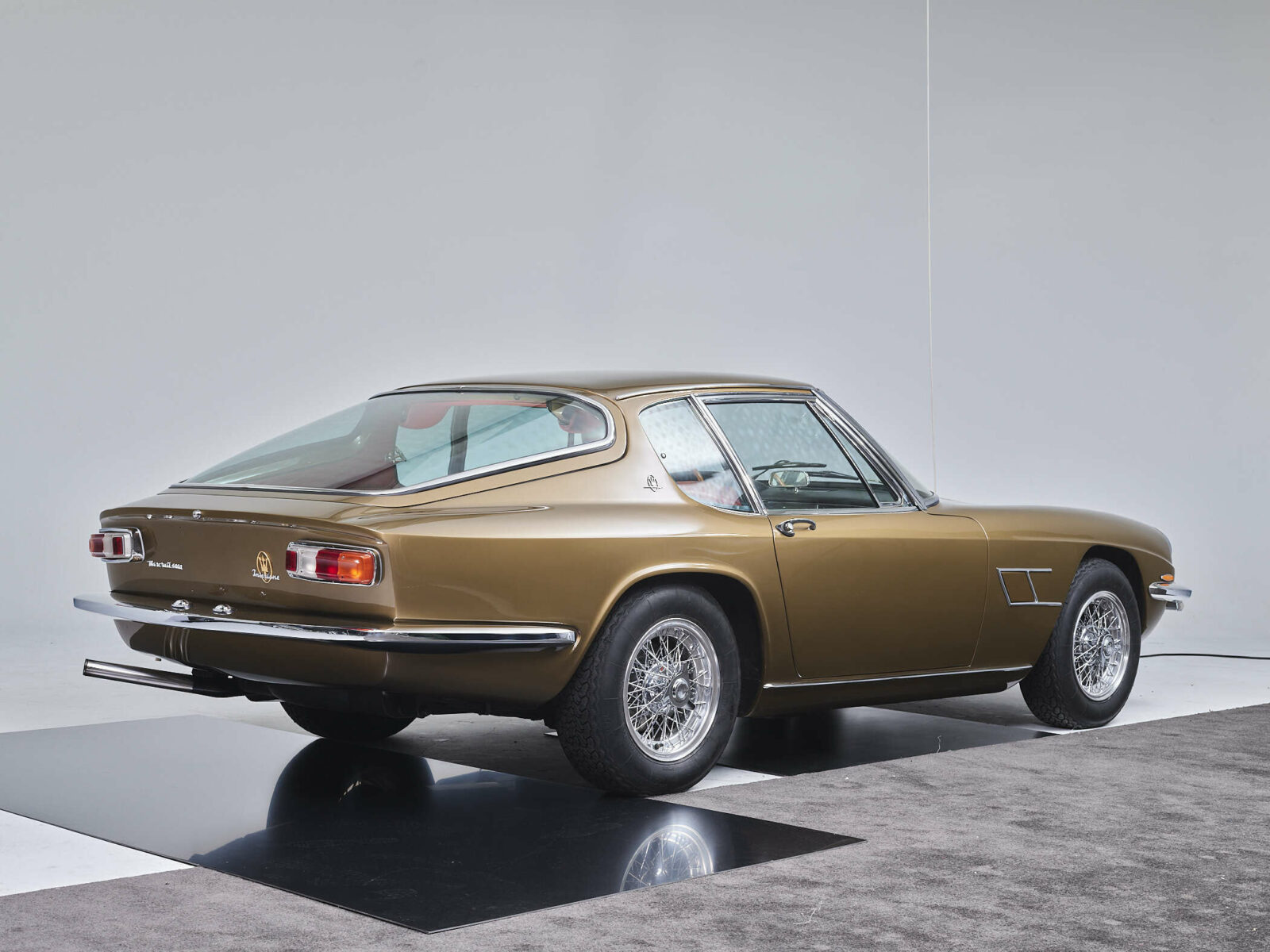
Maserati Mistral
I wouldn't have blamed the salesmen if they had sent me away as I must have been a bit of a nuisance but they didn't, perhaps knowing that one day soon I'd be back with a cheque in my hand and a smile on my face as I bought my first car from them. It may also have been because one salesman in particular was a real car nut and delighted in telling me everything there was to know about every vehicle on the lot, which broadened my knowledge of cars immensely. One day I went in and, sitting there in the driveway was a brand new Maserati Mistral. The dealer had it for just 24 hours as its owner was scheduled to take delivery of it on the following day. With a glint in his eye, he jumped in the driver's seat, pushed opened the door and said, "Climb in". It was my first drive in a Maserati, in fact it was my first drive in an Italian car and I cherished all three minutes of our trek around the block. Enveloped in a gorgeous white leather seat that grabbed me like a glove, I marvelled each time I was pushed back into it as we turned a corner and accelerated away. It was 180 seconds of sheer delight.
As a memento of this unforgettable ride, I was given a Maserati
Mistral sales booklet, which was to become the first of hundreds of
brochures from car manufacturers all over the world that I began
collecting at that time. Sadly I no longer have this collection as, a
year after getting married, my wife and my mother had a spring clean
and threw out the dusty box in which I stored them under the bed,
believing it to contain 'junk'. I try not to think about it these days
as I am acutely aware of the dangers of high blood pressure. When I
wasn't up the west end of town I'd be at the eastern end of Murray
Street where the showrooms of the British car manufacturers displayed
their wares. I loved the Jags but I was never allowed to sit in them. I
always asked if could sit in the E-types but always got the same
answer. The same applied to the Rolls Royce cars next door, though that
didn't bother me as I could never see myself owning one as they just
weren't me.
There was little in the BMC showroom that interested me beyond the MGB
until the Austin 1800 came along. Initially the Rootes Group's line-up
of Hillmans, Singers and Humbers held no attraction either apart from
the Triumph Spitfire, that is, until Dad asked me to look for a
replacement for his Austin Cambridge. We had kept the car after the
accident and had it repaired, but there were too many bad memories
attached to it for us to keep it. I knew that he wouldn't be happy with
anything but an English car because, in his mind, they were the best,
so I headed straight for Murray Street and checked out what was on
offer. The car I picked out for Dad to test drive was a white Humber
Vogue Sports Series II. He was quite taken by its genuine leather seats
and upmarket level of appointments, so he took it for a drive and
bought it without even checking what else was on offer at the other car
yards. He drove that Humber for over 10 years, it ran faultlessly and
he always looked upon it as the best car he had ever owned.
The World in 1966My recollection of 1966 is that of a year of sharp contrasts. The peace/anti-war movement was almost at its zenith, thanks in no small measure to singers like Bob Dylan, Joan Baez and Peter, Paul & Mary whose peace anthems had been adopted by the youth of the world. From the protest movement would come the love-ins, Woodstock and the whole Hippie culture later in the decade where drugs and sex would be freely shared. Opposition to US involvement in the escalating Vietnam War was rising, particularly among the nation's youth, demonstrations were commonplace and the injury toll as more and more demonstrations turned into riots was on the rise. Such was also the case in America's deep south where the fight for equal rights for black citizens was met with strong, violent opposition from certain corners of the white community.
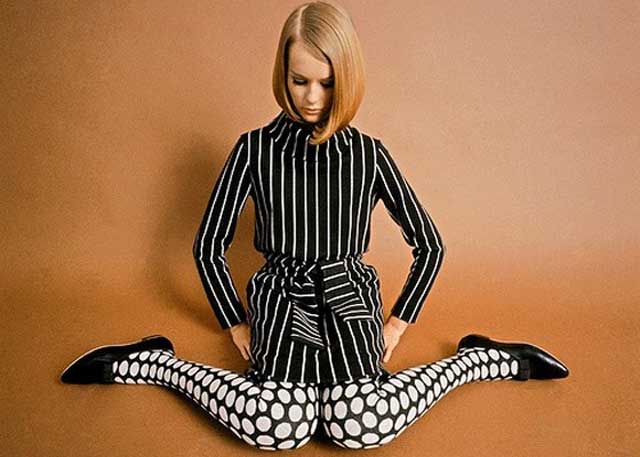
Mary Quant
In direct contrast to the unrest in America was the 'high' being
experienced on the other side of the Atlantic. The Beatles and their
music had conquered the world, Britain was the centre of the popular
music world and its capital, which had been dubbed 'Swinging London' by
the media, was the fashion capital of the world. A designer named Mary
Quant had set it all in motion when she opened her shop Bazaar on the
Kings Road in London. Her garments liberated women from the tyranny of
the traditional long skirt and cardigan, her series of fresh,
innovative designs introducing both the mini skirt and tights (which
replaced stockings and suspender belts). Described as the "major
fashion force in the world outside Paris", In 1966 Miss Quant received
an OBE and is remembered today as a key figure in the rise of "Swinging
London", and her name is synonymous with 60s fashions. 1966 began as it
would end - with a call for peace. On New Year's Day, Pope Paul VI
appealed for peace in Vietnam but such was not to be. Within a week, a
further 8,000 GIs launched the war's biggest attack thus far against
the "Iron Triangle", a Viet Cong stronghold near Saigon. President
Johnson met the South Vietnamese leaders in Honolulu at beginning of
February but a failure to resolve the issues saw the US resume bombing
raids on North Vietnam a week later.
In February, the space race saw the Soviet Union ahead when the unmanned Soviet spacecraft Luna 9 made the first soft landing on the Moon and an unmanned Soviet spacecraft landed on Venus. A month later, US spacecraft Gemini 8 carried out the first docking operation in space. On 15th March, Black teenagers rioted in Watts, Los Angeles; two men were killed and at least 25 were injured as preparations were being made in the Vatican for the first official meeting for 400 years of the heads of the Roman Catholic and Anglican churches. The Pope and the Archbishop of Canterbury embrace and exchange a "kiss of peace".
In May, the US admitted to firing on targets in Cambodia for the first time as opposition at home mounted. 10,000 anti-war demonstrators picketed the White House while the pledges of 63,000 voters to vote only for anti-war candidates were displayed at the Washington Monument. In August, 17 Australian soldiers were killed in a savage battle at Long Tan, where two platoons of the 6th Battalion were encircled by the Viet Cong and a number of US soldiers died when US planes napalmed Americans by mistake. Casualty reports show that 5,008 US troops were killed in Vietnam in 1966, with 30,093 wounded. The US now had close to 400,000 troops in Southeast Asia. Racial tension continued throughout the US south. In June, James Meredith, the first Negro to brave the colour bar at the university of Mississippi in 1962, was shot in the back as he entered Mississippi on a civil rights march. He was taken to hospital in Memphis and survived. The next day, Dr Martin Luther King led a civil rights march through Mississippi, starting from the point on US Highway 51 where Meredith had been gunned down. Meredith rejoins civil rights marchers near Jackson, Mississippi two weeks later.
In a classic case of the pot calling the kettle black, Britain and
the US led an international protest against France for exploding a
nuclear bomb on Mururoa Atoll in the South Pacific on 2nd July.
Australia was among the other protesting nations. In August, Chairman
Mao proclaimed a Chinese cultural revolution at a mass rally in Peking
and The Beatles played their final live concert at Candlestick Park,
San Francisco. In Sptember, South African Prime Minister Dr Hendrik
Verwoerd, the father of apartheid, was knifed to death by a
parliamentary messenger. Balthazar Johannes Vorster became his
replacement. A Welsh coal tip slipped and engulfed a school, burying
116 children and 28 adults alive at the mining village of Aberfan in
South Wales. The US continued its push for supremacy in space as James
Lovell and Edwin 'Buzz' Aldrin splashed down in October after five days
orbiting the Earth in Gemini 12, the last Gemini mission. NASA later
released close-up photos of the Moon taken by Orbiter 2.
During 1966, the world mourned the loss of silent screen, Buster
Keaton; US actor Montgomery Clift (b. 1920); US Comedian Lenny Bruce;
Canadian-born US cosmetics expert Elizabeth Arden; movie mogul Walt
Disney. In their place, we welcomed Janet Jackson, who was born on 16th
May. In 1966, air travel was in the process of replacing sea travel as
the most popular form of passage between countries and continents, and
the incidence of aircraft accidents increased markedly in that year.
133 people were killed when an airliner crashed into Tokyo Bay, Japan
in January. In March, 130 died when a British Boeing 707 crashed into
Mount Fuji in Tokyo, Japan. A month later, 92 died when a British
airliner went down in Yugoslavia. Australia had its own taste of
tragedy when, on 22nd September, 29 people aboard an Ansett ANA
Viscount died when it crashed near Winton, Queensland. On 10th December
a helicopter on charter to the ABC crashed at Circular Quay, Sydney,
killing three people.
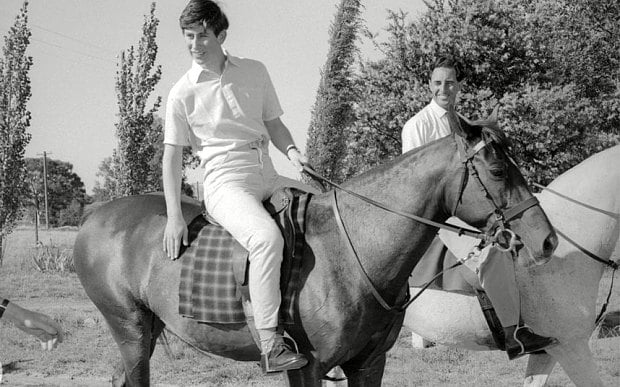
Prince Charles at Timbertop
Australia in 1966On 5th January, Pentridge Prison
escapees Ronald Ryan and Peter Walker are captured in Concord, Sydney.
The two had been on the run for 17 days since shooting dead a warder
and walking out of Pentridge Prison, Melbourne, with a Salvation Army
chaplain as hostage. A few weeks later, Robert Helpmann was named
Australian of the Year and Australia’s Prime
Minister Robert Menzies
retired after 16 years in office. He was succeeded by Harold Holt. Dame
Annabelle Rankin became the first woman to serve as a government
minister in Australia. She became the Minister for Housing in the new
Holt Ministry. Two days after Australia Day, the country was shocked by
the news that three children had disappeared from a crowded beach at
Glenelg in South Australia. The mystery of what happened to the
Beaumont children remains unsolved to this day. As hotel trading hours
in Victoria were extended from 6pm to 10pm at the beginning of
February, Prince Charles began his term in the bush at Geelong
Grammar's Timbertop school, near Mansfield in Victoria's high country.
He completed his time at Timbertop on 11th August, decribing it as "a
marvellous and a worthwhile experience".
On 14th February, Australia switched to Decimal currency. Midway
through its construction, Danish architect Joern Utzon left the
unfinished Sydney Opera House he had designed on 28th Frbruary,
following a series of confrontations with the NSW government. On 25th
March, Flinders University, Adelaide, was officially opened. The day
before Anzac Day, the first of the 4,500- man Australian Army task
force, most of them conscripts engaged in national service, left for
Vietnam from Richmond RAAF base in Sydney. A month later, Private Errol
Wayne Noack, 21, became the first Australian conscript to be killed in
Vietnam.
On 21st June, the Leader of the Australian Federal Opposition,
Arthur Calwell, was shot and injured as he left an anti-Vietnam
conscription meeting in Mosman Town Hall in Sydney. As he recovered in
Hospital, the Australian Prime Minister Harold Holt promised the US
that Australia would go "all the way with LBJ" over Vietnam. Peter
Raymond Kocan, 19, was later sentenced to life imprisonment in Sydney
for his attempt on Calwell's life.
In August, Australia sent a team of athletes to the Commonwealth Games
in Jamaica, the first Commonwealth Games after Perth had played host in
1962. For the first time, the word "Empire" was dropped from the old
title of Empire and Commonwealth Games. In October, US President Lyndon
Johnson arrived in Australia on an official visit. The visit was dogged
by ugly demonstrations. Melbourne brothers John and David Langley were
fined $680 each for throwing paint bombs at President Johnson's car.
Prime Minister Holt was later mobbed by anti-Vietnam demonstrators
during his election campaign in Sydney. In spite of the opposition,
Holt committed a further 1,500 troops to the Vietnam conflict, making a
total of 6,000 of Australian troops involved. At the beginning of
December, 4,530 Qantas employees had to be laid off because of a
pilot's strike that was crippling the airline. The month long strike
ended four days before Christmas.
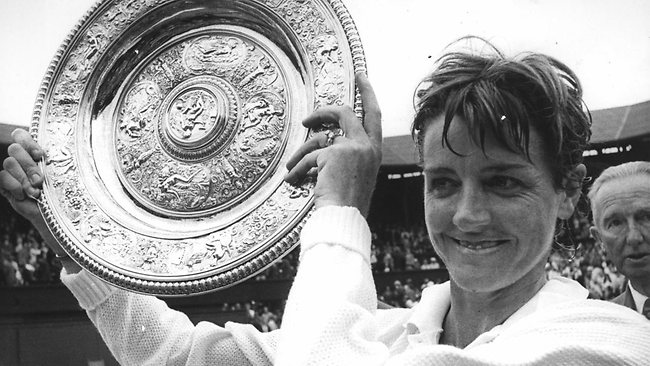
Margaret Court
English FA Cup Final: Everton 3 beat Sheffield Wednesday 2 Soccer World Cup: England 4 beat Germany 2 at Wembley to win the for the first time. Tennis: Margaret Court was Australian singles champion. Spain's Manuel Santana beat Dennis Ralston (USA) in the men's singles final at Wimbledon. Billie-Jean King beat Maria Bueno for the women's title. Davis Cup - Australia (4) d. India (1) Federation Cup - United States (3) d. Germany (0) Motor sport: Jack Brabham won the World Championship (one of three years in which he achieved this). His 1966 victory was in a self-designed car. Brabham was Australian of the Year in 1966. Surfing: Robert 'Nat' Young won the World Surfboard Championship in San Diego.
The most popular songs of 1966 included: Green, Green Grass of Home
(Tom Jones); Strangers in the Night (Frank Sinatra); Born Free (Matt
Monro);
Que Sera Sera (Normie Rowe); These Boots Were made for Walking (Nancy
Sinatra); Winchester Cathedral (New Vaudeville Band); The Sound of
Silence (Simon & Garfunkel); Monday Monday (Mamas & Papas);
Summer in the City (Lovin' Spoonful); I'm a Believer (The Monkees);
Good Vibrations (The Beach Boys); You Keep Me Hanging on (The
Supremes); Hitch Hiker (Bobby & Laurie); Yellow Submarine (The
Beatles); Eleanor Rigby (The Beatles); Daytripper (The Beatles);
Norwegian Wood (The Beatles); Lady Jane (Rolling Stones); Friday on My
Mind (The Easybeats); My Generation (The Who); Step Back (Johnny
Young); Wild Thing (The Troggs); The Carnival Is Over (The Seekers);
Come & See Her (The Easybeats); Tar & Cement (Verdelle Smith);
I'll Make You Happy (The Easybeats)
The most popular movies of 1966 included:
Alfie (Michael Caine, Shelley Winters); The Blue Max (George Peppard,
James Mason, Ursula Andress); The Fortune Cookie (Jack Lemmon, Walter
Matthau); Hawaii (Julie Andrews, Max von Sydow); A Man for All Seasons
(Paul Scofield, Robert Shaw); They're a Weird Mob (Walter Chiari, Clare
Dunne); Who's Afraid of Virginia Woolf? (Elizabeth Taylor, Richard
Burton).
Design by W3layouts