
Thank you for the music: Favourite Australian Popular Songs
What About Me
(Garry Frost/1981) Moving Pictures
"Days Of Innocence", the 1981 album of Aussie R&B band, Moving Pictures, featured many strong ballads that belied their live act. The biggest of these was the single "What About Me", which had been written by Garry Frost who, at the time was working with autistic children in his day job. He'd literally gone out to get lunch at his local shop in the Sydney suburb of Annandale and seen a small boy not being noticed waiting at the counter. He was moved by the vision sufficiently to pen the song. It was rarely played live by the band, and when it was it was in a modern country style. It was destined to never be recorded had their debut album's producer Charles Fisher not heard Frost and Smith tinkling around with the tune on the studio piano during a break in recording. Fisher had Moving Pictures record the song against their better judgement as it was not the direction they wanted to go. "What About Me", with its classical sounding kettle drum roll at the beginning, stayed at the top of the Australian music charts for seven weeks. It also made the American Top 20.
Moving Pictures were signed to the Elektra distribution label in the US and just as the song started to chart very successfully there, Elektra went broke. This was Moving Pictures only chance of making it in the US and it was shot. Ironically, the success of "What About Me" signalled the beginning of the end for Moving Pictures. Garry left the band in 1984, feeling it had lost its direction. Other band members followed one by one and they eventually disbanded in 1987, but their song that shone so brightly remains. It was re-recorded and made a hit in 2004 by Australian Idol runner up, Shannon Noll.
Now I Can Dance
(Tina Arena - David Tyson/1997) Tina Arena
A flamenco-tainted shuffle that skips a merry line against strummed guitars and a sea of percussion. There's some delicately picked guitar that highlights the middle of this subtle, pretty, understated song that lasts nearly six minutes. It is about a performer who has broken free from the confines of a family that had questioned her abilities and motives. The song takes the form of a 'thank you' letter to a friend back home who supported her and helped her get her freedom, but who, in so doing, has lost her. All round, a delightful song that expresses both the up and down sides of moving on in life, and while Tina's not saying, I think the song is about her breaking free from her identity as a Young Talent Timer, a past that seems to haunt her and one she is desperate to shake off.
The line "freedom I hold so dear, nobody knows me here" perhaps refers to her success in France where her past as a child star on YTT is not known. Her past on YTT was such a bugbear for her, she even named one of her albums "Don't ask", referring to questions being constantly put to her at the time about her child star status and its influence on her "adult" career. Tina was born Filippina (Pina for short) Lydia Arena on 1st November 1967, in Moonee Ponds, Melbourne. She is the middle of three sisters who are of Italian descent. Tina took singing lessons and at the age of seven began her career as "Tiny Tina" on the Australian talent television show Young Talent Time. She returned to the spotlight in 1985, when shed her 'child star' image and developed an international audience. The song "Now I Can Dance" is on Tina's In Deep album, which was recorded predominantly live in the studio in an attempt to bring the material closer to Tina's stage performance persona.
The Real Thing
(Johnny Young/1969) Russell Morris
"Do you know what I like best about all this?" asks its writer, Johnny Young. "It's hearing people say, 'Johnny Young didn't write The Real Thing'.' It's great that I'm so identified with Young Talent Time that they get blown away when they find out I wrote it." Young had already been through a few different careers by the time 'The Real Thing' became a number one hit in May 1969. He had his own television show at the age of 16, then became a bona fide pop star in the mid-60s with songs such as 'Cara-lyn' and 'Step Back'. By 1967, he had made the obligatory trip to the UK and was getting songwriting tips from Barry Gibb of the Bee Gees with whom he was sharing a flat in London. "You can't really get a better teacher than that," he says. "Barry basically taught me the structure of a song, where to put a middle eight, and the importance of a guitar lick that can serve as a great hook."
When he returned to Australia, John Farnham had taken his place as king of pop, so Johnny turned to songwriting. One Friday night after playing a gig with a band, the 21 year old Johnny started playing around with a few chords that were floating around in his head. "At the time everything was telling you to do this, or do that, because 'it's real'," he recalls. "I wanted to say no to all that - I am the real thing, you are the real thing, we are the real thing." He put on tape his ideas and by 2am had 20 minutes worth of material. Young intended to use the song for his own band, but Molly Meldrum heard the band playing around with it soon afterwards in the dressing room for Uptight, a morning TV show, and insisted Young give him the song for Russell Morris (right), who he was managing at the time.
"I give Molly 100 per cent credit for what he did producing 'The Real Thing. He can be an incredible bullshit artist, but in a studio he can be a genius. Considering the time and the technology back in 1969, what he achieved was incredible. It wouldn't have been a hit if I'd sung it. My time as pop star was over. Russell Morris was unique, like a Roy Orbison, and I was like a Frankie Avalon. The reality was that it was the right song by the right person at the right time."
'The Real Thing' became more something of Meldrum's creation than either Russell's or Johnny's. Russell just sang it. Johnny just happened to have written the basis for it. In the studio, using The Groop as backing musicians, Meldrum spent unprecedented hours and money to create a seven-minute production extravaganza, complete with The Groop's Brian Cadd reading from the side of a recording tape box for an imitation Hitler speech. The song was released to shocked radio programmers who had never been asked to play such a long Australian single before. It reached Number One nationally in June 1969 and newcomer Russell Morris was instantly challenging Johnny Farnham as Australia's pop king. Without any promotional support from Russell 'The Real Thing' even reached Number One in Chicago, Houston and New York, making it the first song by an Aussie outfit to achieve No. 1 status in the US.
Ford's Bridge
(Brian Cadd/Don Mudie/1969) Axiom
This was another song from Axiom's 'Fool's Gold' album of 1969, also penned by Don Mudie and Brian Cadd and sung by Glenn Shorrock. Unlike 'Arkansas Grass', this was very much an Aussie ballad about Australian people and places - Ford's Bridge (the actual bridge is spelt Foords Bridge) being located on the Murray River and joining the towns of Wahgunyah and Corowa. The song tells the sad story of a simple young man who is devastated when a girl he secret admires falls in love with and marries a returned soldier. Unable to cope, he murders them both. The orchestration of the song close to the standard of what George Martin was doing for The Beatles and took Australian pop music of that time to a new level of excellence.
Arkansas Grass
(Brian Cadd/Don Mudie/1969) Axiom
Released around Christmas 1969 by Australia's first super-group, Axiom, this unashamedly American song was written by band members Don Mudie and Brian Cadd (right) and sung by Glenn Shorrock. The latter had cut his teeth as lead singer of The Twilights and went on to front Little River Band; Cadd was emerging as one of the best songwriters this country has ever produced. 'Arkansas Grass' was released as a single and one of a number of fine songs on the band's album, 'Fool's Gold', which rock historian Glenn A Baker has accurately described as " the first truly important and accomplished rock album". Telling the story of an American Civil War soldiers who'd rather be home than fighting someone else's war, its has all the feel of the period it portrays as well as being a protest song about war that were popular anthems of the peace movement of the late 1960s.
Eagle Rock
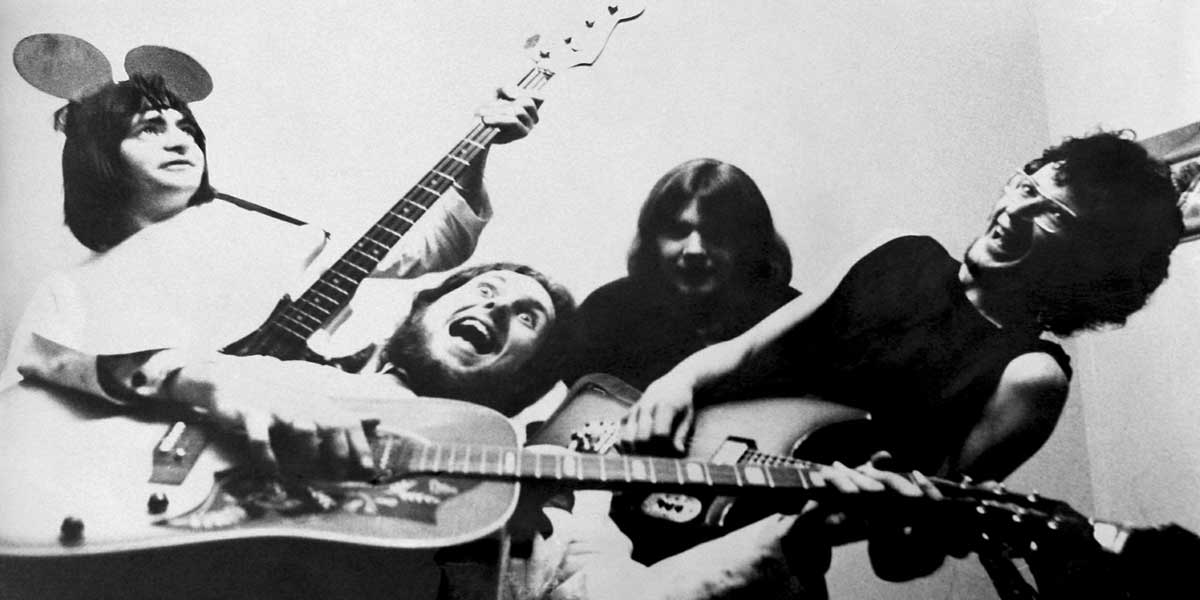
(Ross Wilson/1971) Daddy Cool
"Some Negroes cut the chicken wing and do the eagle rock." That was the caption accompanying a photo of a group of dancing African-Americans which appeared under "blues" as part of a music-dictionary series in The Sunday Times Magazine in 1969. One person who took special note of that caption was Ross Wilson, who had travelled from Melbourne to London to sing in a group called Procession. "That phrase, 'do the eagle rock', stuck in my head," says Wilson. "At the same time I was mucking around with the guitar, trying to learn finger-picking styles and listening to compilations of rural blues from the 1920s and 1930s."
He had come up with the distinctive guitar riff, the title and a few words before Procession disintegrated, and Wilson and wife Pat made their way overland across Europe, the Middle East and Asia, eventually landing in Darwin. They ran out of money, so he got a job in a hotel in order to raise the bus fare back to Melbourne. "I remember spending hours pruning bougainvillaea and coming up with more ideas for Eagle Rock, Come Back Again and Hi Honey Ho in my head, because I had no access to a guitar. I finished the Eagle Rock chorus when I finally got back to Melbourne in 1970."
Wilson remembers playing an early version of the song with his prog-rock band Sons Of The Vegetal Mother, but it wasn't until he formed Daddy Cool (right) later that year that the song took the shape we know today. Wilson maintains that even though it sounds like a simple song, "a lot of musicians find it difficult to play, because it's hard to nail the right feel". In June 1971 Eagle Rock went to number one in Australia and became an instant classic.
It is believed the song influenced Elton John into making a directional change in his career. "We got back from our first trip to America and we heard that Elton John had been to Australia on tour and had been telling interviewers that he liked Eagle Rock and Come Back Again. Not long afterwards he changed his whole persona with Crocodile Rock, where the thrust of the song is reminiscing about a dance we used to do when we were kids, and on the Honky Chateau album cover, Bernie Taupin [John's lyricist] is wearing a 'Daddy Who?' badge."