
Thank you for the music: Favourite Australian Popular Songs
Down Under
(Colin Hay/1981) Men At Work, 1981
The song, which topped the charts in Australia in late 1981 and followed suit in the US and the UK in 1982, got its first spark of life from a cassette made by Ron Strykert, who played guitar with Hay in Melbourne band Men At Work. Mucking around at home, Strykert had filled up a bunch of bottles with different levels of water and struck them to come up with a percussive melody. The opening of Down Under is a reference to that tape. Hay got the idea for the chorus melody while in his car. "It was 1978 and I was driving down Power Street in Hawthorn," he recalls. "It just popped into my head. The verses and all the chords came a day or two later. It took about half an hour or 45 minutes and they were done."
Hay had come to live in Australia from his native Scotland at the age of 14, and he feels that it was his fascination with his new country that fuelled the song. "The chorus was coming from the standpoint of my fear and trepidation of Australia becoming Americanised and overdeveloped, and in the process losing its spirit. The verses were more the Barry McKenzie aspect of the song, and that thing where it's almost a rite of passage for young Australians to travel through Asia and India, and go back to find out where their families come from in England or Ireland or Scotland." As for the famous line about the Vegemite sandwich, Hay actually did have a friend who walked into a bakery in Brussels and was attempting to converse in the native tongue when the guy behind the counter explained that he was from Brunswick in Melbourne. The song was "a lot slower and more dreamy" at first, before developing into the bouncy tune that forever became associated in Australia with the 1983 America's Cup challenge.
One day Hay was walking down the Santa Monica promenade and a folk band was playing it. "That was surreal," he said, "but it worked. That's what I love about the song. It doesn't matter what you do with it, it can stand up on its own. I play it in countries where English is not their first language and they have no idea what Vegemite is, but it sparks something in them. The song's been very good to me, so we look after each other quite well."
I Am Australian
(Bruce Woodley - Dobe Newton/1987) The Seekers
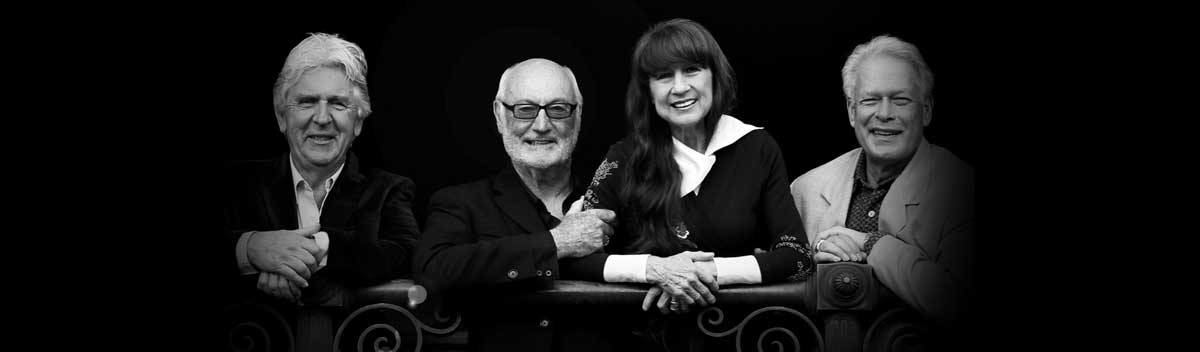
If ever a song deserved to be Australia's national anthem, this would have to be the one. It is very much the song of multicultural Australia of the last 30 years, as it focuses on the fact that the nation of Australia today is made up of people from a variety of cultures and backgrounds who have united as one to become Australians. The first time the song was sung by The Seekers, Julie Anthony was their lead singer. She apparently performed it on occasions, but when Karen Knowles replaced her in 1990, Karen sang it with Bruce (right) at most concerts. The following year, joined by Bruce Woodley and the National Boys Choir, Karen recorded the song which she has since performed at various events including the Prime Minister's Dinner for Melbourne's Olympic Bid.
In May 1997, Judith Durham, Russell Hitchcock (Air Supply) and Mandawuy Yunupingu (Yothu Yindi) collaborated on a version of the song that was released as a single and used in an extensive government media campaign. It reached No. 17 on the national chart in June 1997. Around that time The original Seekers line-up re-formed and it is has been sung by them with Bruce and Judith sharing verses ever since. Karen Knowles' version appear on her album, On A Clear Day. There is also a scrappy version around by Rai Thistlewayte that used to be imposed upon telephone callers to Telstra during their wait in the queue.
When The War Is Over
(Steve Prestwich) Cold Chisel
Cold Chisel, fronted by Jimmy Barnes, produced the canonical example of Australian pub rock. With a string of hits throughout the 1970s and 1980s, they are acknowledged as one of the most popular and successful Australian groups of the period, although this success and acclaim was almost completely restricted to Australia. Their "Forever Now" album stands as one of their most technically refined recordings and still gets airtime on radio and in online video clips in bars and clubs. Drummer Steve Prestwich became the unlikely pop meister of the band after he penned a number of tracks for the album. "He's from the River Mersey. His old man played drums with Gerry and the Pacemakers and those groups. He was the drummer in the house band at the Cavern," says Don Walker enigmatically when quizzed on Prestwich's pop sensibility.
His popular ballad, "When The War Is Over" is the only Cold Chisel track to be covered by other artists on numerous occasions since; first by Little River Band when John Farnham and Steve Prestwich were members of that band (on the No Reins album, 1986), later by a heavy metal band out of England, again by Farnham on his anthology of great Aussie songs and more recently by Aussie songstress Cosima De Vito. Dripping with emotion, it tells of someone's struggle to pull themselves together after enduring a difficult and heart-wrenching break-up.
Rock'n'Roll (I Gave You The Best Years of My Life)
(Kevin Johnson/1973) Kevin Johnson
This is one of those ironic hits about a would-pop star going everywhere from San Francisco to London's Soho looking for his big break, ironic because at the time he wrote it, Johnson had never been outside of Australia. Johnson had already been writing and recording for several years before his first hit, 1971's "Bonnie Please Don't Go (She's Leaving)," which also charted in North America. He landed publishing and record contracts in the US, but both deals saw Johnson's success stagnate, with no real action. The sentiments of the song very much reflected his career at that stage in his life. "There was a lot of frustration because I was living on the smell of an oily rag at this stage. Because I'd signed with an American company I couldn't record here, so I didn't record anything for two years, which was like madness," he recalls. "There was frustration that had been going on for years before 'Bonnie Please Don't Go' and then two years writing and bashing my head against a brick wall."
Johnson wrote this, his biggest hit, in two days. "It was a quick song for me because I've spent months on one line. It just came to me one day as I was driving home, feeling all this frustration of two years without making a record. So I decided to write a song not about giving someone the best years of my life, but to write about the pursuit of success, which I thought related to a lot of people around the world, not just in music but anything. There are elements of a lot of things in the song, like Don McLean did with 'American Pie.'
But what I felt at that time and I'll be damned for saying this was that Australia emulated whatever was happening in all the major centres. So when I said I was 'always one step behind,' I mentioned San Francisco because as soon as San Francisco was happening everybody here was trying to play louder than anybody else with flowers in their hair but about a year after. You can't follow, and that's what everyone in Australia was doing." The song struck a strong chord and remains one of the most memorable songs composed by an Australian. He admires some of the international versions, although he can't understand what French star Joe Dassin was singing, and was amused when Mac Davis changed the song's ending to a happy one. "There were a few people who wouldn't sing, 'I'll never be a star,' because in their mind they were big stars."
In spite of the strange adaptation he did of it for the AFL ("Aussie Rules I thank you for the best years of my life"), Johnson is comfortable with the song's legacy but says, "I have never tried to trade on it. A lot of people come to me and prefer 'Bonnie Please Don't Go' or many other songs to 'Rock and Roll'. So it's only one other song."