
Thank you for the music: Songs I Like To Remember
Deep Purple
Nino Tempo and April Stevens
In 1939, this was a No.1 hit for Larry McClinton and His orchestra. It also went to No.20 for Billy Ward and the Dominoes - their last crossover Top 40 hit, and No.14 for Donny and Marie Osmond in 1976, but the version of the song that everyone remembers is the1963 hit of Nino Tempo and April Stevens. The brother and sister duo, whose real names are Antonio and Carol Lo Tempio, each had fair solo careers. April had hits with 'No No No Not That' (1950), 'I'm in Love Again' (1951), and 'Teach Me Tiger' (1959) in the US; Nino was a session saxophonist. During the last remaining 14 minutes of a recording session, to use up the time April suggested they record this song; she had just been listening to the Billy Ward version and liked it. Recalls April: "In rehearsal, Nino sat at the piano and started being very funny with the song, and we laughed ... but then, we stopped and said "Gee, it sounds good...kinda country." Adds Nino: "I didn't have enough range to sing 'Deep Purple? as originally written, so I used a falsetto, just kidding around. She was laughing, and I was laughing...then this girl walked in and said "I love that!?" April: "And then Nino decided to sing one chorus alone, without me, and he didn?t know the words ... so I started to softly feed him the words. We didn?t know what we were doing. But this girl said "I love the way you're talking and he's singing, so I thought maybe it?s a good idea."
It took April two months to convince Nino that the narration was OK. The record company wasn't too keen on it either and mothballed the song for a year. When it was finally released it shot to No.1 in the US and gave the duet their one and only international Top 10 hit. Released with the intention of being the B-side, 'Deep Purple' not only won the Grammy for Best Rock & Roll Recording of 1963 but inspired the name of one of the first heavy metal rock bands.
American Pie
(Don McLean) Don McLean
Initially inspired by his memories of the death of Buddy Holly in 1959, 'American Pie' is autobiographical and presents an abstract story of Don McLean's life from the mid 1950s until when he wrote the song in the late 1960s. It is almost entirely symbolised by the evolution of popular music over these years and represents a change from the lightness of the 1950s to the darkness of the late 1960s. In Don's life the transition from light (the innocence of childhood) to the darker realities of adulthood probably started with the death of Buddy Holly and culminated with the assassination of President Kennedy in 1963. In this four year period, Don moved from a fairly idyllic childhood existence, through the shock and subsequent harsh realities of his father's death in 1961, to his decision in 1963 to quit Villanova University to pursue his dream and become a professional singer.
For more than 30 years the lyrics of American Pie have been subject to intense scrutiny as people search for the song's real meaning. Analysis continues today on the Internet and in newspapers and magazines worldwide. However you interpret the lyrics, the essence of the song is the degeneration of America and McLean's longing for the wholesome days of the 1950s when musicians were God fearing.
Living Next Door To Alice
Smokie
This much maligned song from 1976, about two girls next door - one he fell in love with but didn't have the guts to tell her, and the other who fell in love with him but didn't have the guts to tell him - was a number one hit for Smokie and set their career in motion. A beautiful introduction played on an acoustic Martin 12-string guitar, sets the mood for a rather sad ballad ably sung by Smokie lead singer, Chris Norman. The members of Smokie, a pop band from Yorkshire, England, had previously performed together in 1966 with a band called The Elizabethans. Turning professional in 1968, they changed their name to Kindness, performing at holiday camps and ballrooms. Along the way they changed their name to Smokey (later spelt Smokie), and had a string of hits including this one.
In 1976 the production team of Nicky Chinn and Mike Chapman (Chinnichap) were looking for a band to work with, spotted Smokie and wrote this song for them. Smokie lasted four years, disbanding in 1980. A little while ago a dreadful version of the song was released that was essentially the same as the original but with the comment "Alice, who the f___ is Alice?" overdubbed throughout the chorus. Whoever did that should be shot!
Everybody's Somebody's Fool
(Howie Greenfield; Jack Keller) Connie Francis
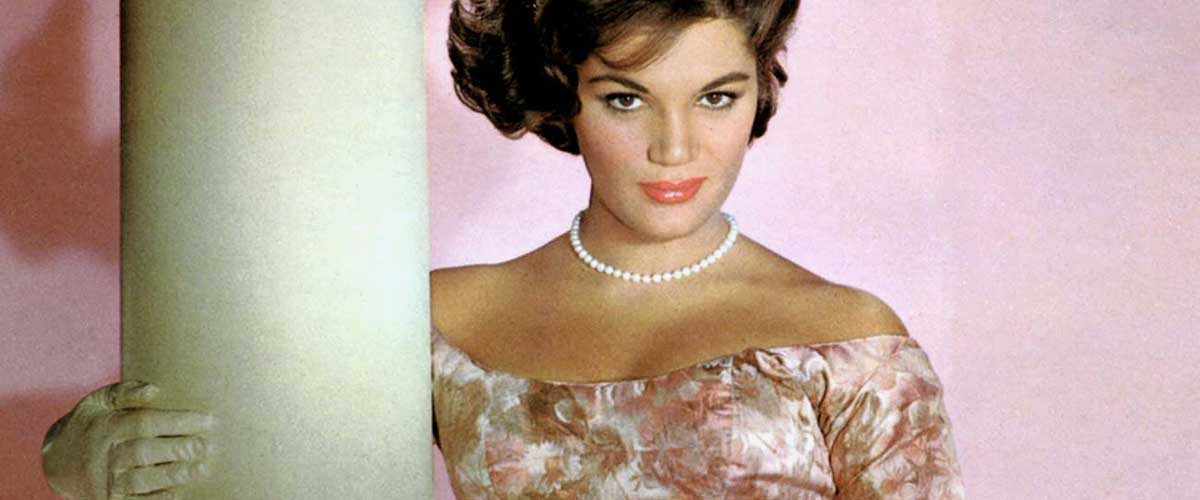
Now we are digging deep into the archives, aren't we? 'Everybody's Somebody's Fool' was a No. 1 hit for Connie Francis (right) in 1960. It was in fact the first song I ever heard on Australian radio upon my arrival as a 9-year old migrant kid in that year. Back then, young female singers like Connie Franics, Connie Stevens, Little Peggy March, Diane Renay, Brenda Lee and Leslie Gore were all the rage. Their songs about teenage romance and broken hearts were snapped up by male and female teenagers alike and these girls enjoyed hit after hit with similar sounding songs that were rushed recorded and released to satisfy an eager public. But that all ground to a halt in 1962-63 when the Beatles and their fellow Liverpudlians turned contemporary music on its ear and these pretty-faced songstresses became has-beens almost overnight.
'Everybody's Somebody's Fool' was written by Howie Greenfield and Jack Keller who were employed by Aldon Music, Don Kirschner's Brill Building publishing company. They were part of a stable of young pop songwriters that also included Gerry Goffin, Carole King and Neil Sedaka and wrote most of the popular songs of the early 1960s between them. Keller and Greenfield also wrote 'My Heart Has a Mind of Its Own', another No. 1 hit for Connie Francis in 1960, 'Venus in Blue Jeans' for Jimmy Clanton and the theme songs for the TV shows Bewitched and Gidget. Keller died in April 2005, age 68. Greenfield died in 1986. During the 1960s, Greenfield and Neil Sedaka wrote many of the latter's hits, including 'Love Will Keep Us Together', 'Breaking Up Is Hart to Do', 'Little Devil', 'Happy Birthday Sweet Sixteen' and 'Calendar Girl'.
Though their songs had a simple backing back then - this one featured only a Hammond organ, drums played with brushes and a strummed acoustic guitar - these songwriters were quite skilled in writing about innocent teenage emotions and the singers sang clearly and with enough emotion to convince their audience that they were singing from the heart. Connie Francis melted even the hardest stony heart with her melancholy delivery of this song. Showing her versatility, she then gave a bubbly performance singing 'V-A-C-A-T-I-O-N' two years later. Though 'Everybody's Somebody's Fool' sounds quite dated these days, Connie's voice has sufficient charm and charisma to keep me listening forty five years on. She continues working the United States concert circuit as a classy and very popular performer.
Monday Monday
(Denny Doherty) The Mammas & The Pappas
At a time when The Easybeats had Friday on their minds, a newly formed California-based group called The Mamas and the Papas were pre-occupied with Monday. One evening while awaiting the release of "California Dreamin'," band member Denny Doherty was prodding songwriter John Phillips to come up with some new material. Phillips said he would come back in the morning with "a song with universal appeal". Ignoring the sarcastic comments from the group members, Phillips came up with this, their biggest hit, about not knowing what surprises a new day or a new week may bring. Denny and Michelle apparently hated the song when they first heard it; when they were told it was to be their next single, Michelle was horrified and thought it would end their careers. Forced to eat humble pie, Denny was later quoted as saying, "Who knew? - What do I know about music!" This is believed be be the first ever popular song to use a pause as a musical device - about three seconds in length, just after the second chorus, toward the end of the song. There were lots of imitators after this, and the pause became commonplace, but "Monday Monday" did it first. When it was first played, many DJ's thought the song had ended right there and started talking.
'Monday, Monday' was released in 1965 on an incredibly successful album named 'If You Can't Believe Your Eyes And Ears'. With this album, the band struck gold. 'Monday, Monday', 'Do You Wanna Dance', 'Go Where You Wanna Go', 'California Dreamin'' and 'Spanish Harlem' were all on the album and all went into the top 5 as A or B-sides of the group's first four singles. In the history of popular music, only The Beatles and Elvis Presley have equalled that feat. In 1966, an up-and-coming singer/songwriter named Neil Diamond recorded 'Monday, Monday' and it was released on the B-side of his first big hit, 'Solitary Man'.
Brother's Love's Travelling Salvation Show
(Niel Diamond) Niel Diamond
This 1969 hit from singer/songwriter Neil Diamond is an example of the quality of material produced by this artist as he was about to enter his creative peak, though it was the only outstanding song on the otherwise forgettable album, 'Two-Bit Manchild'. The song begins with a simple piano introduction, and like the preacher about which the song is written, 'suddenly, soft and low, like a small earthquake, and when he lets go, half the valley quakes ...". 'Cracklin' Rosie', 'Crunchy Granola Suite' and 'Song Sung Blue' were three other big Neil Diamond hits from this period but these songs were marred by a bit of accidental or deliberate plagiarism. The introduction of 'Cracklin' Rosie' is a direct lift of the introduction of 'The Pennsylvania Polka'; the tune of 'Song Sung Blue' is a slight variation on a Beethoven Piano sonata.
The live version of 'Crunchy Granola Suite' on the album 'Hot August Night' has a line or two from 'In The Mood' added as a counter theme. Of the song, Neil says; " I was on my way south to Memphis to record there for the first time. I was so excited that on the plane I wrote an entirely new set of lyrics (my second airplane song lyric) to a song I had already written. The story of 'Brother love' demanded its own place in those sessions and was recorded the following day with nary a change in lyric. This recording became a hit and was to make a showman out of me. How could you not let go of your inhibitions when playing such a wonderful character?"