Muliple Unit Passenger Trains: Victoria
High Capacity Metro Trains
The High Capacity Metro Train (HCMT) is a type of electric multiple unit (EMU) train for use by Metro Trains Melbourne on the Melbourne rail network. The first train set entered service on 27 December 2020 and will become the primary rolling stock used in the Metro Tunnel when it opens in 2025. The HCMTs carry around 1,400 passengers in seven carriages, running on Melbourne's 1,500 V DC overhead catenary system, and are currently the most advanced trains in the Metro Trains fleet. A consortium of investors and rail companies are constructing the trains in China and Australia via a contract with the Victorian Government, in addition to upgrade works necessary for the operation of the trains.
Siemens Nexas Metro Trains
The Siemens Nexas is a class of electric multiple units manufactured by Siemens Transportation Systems for the suburban railway network of Melbourne between 2002 and 2005. The design of the trains was based on the Siemens Modular Metro. The original order was for 62 3-car sets, with an option for an additional ten 3-car sets. In December 2002 just before the first was delivered, National Express handed the M>Train franchise back to the Government of Victoria, thus the first Siemens Nexas' were delivered to the government. All passed to Connex Melbourne in April 2004. The option for ten additional trains was exercised in August 2005, with the last of these delivered in January 2006.
X'Trapolis 100 Metro Trains
The X'Trapolis 100 is a class of single deck electric multiple units part of Alstom's X'Trapolis family of trains, operated in Melbourne and Valparaíso, Chile. When originally introduced to the suburban network in 2002, the trains operated only on the former Hillside network (consisting of the Burnley and Clifton Hill group lines), and did not run revenue services elsewhere operated by M>Train on the Bayside Trains half of the system. Although the networks merged in 2004, when Connex took over all operations, the X'trapolis units did not operate on the Bayside system at the time.
Comeng Suburban Trains
The Comeng electric multiple unit (EMU) operate on the suburban railway network of Melbourne, Victoria, Australia. Built by Commonwealth Engineering (Comeng) in Dandenong, they were introduced in 1981 as a replacement for the Tait and Harris trains. In total, 570 carriages (380 motor cars and 190 trailer cars, a total of 95 six carriage sets) were built. Comeng trains are single deck and are semi-permanently coupled as M-T-M (motor-trailer-motor) sets. Most frequently, they are coupled as M-T-M-M-T-M (six-car) sets. Comeng trains have power operated doors that must be pulled open by hand but are closed by the driver. The trains were the first suburban trains in Melbourne to have air-conditioning in the passenger saloon.
Hitachi Suburban Trains
The Hitachi (also known as Martin & King or Stainless Steel) is an electric multiple unit that operated on the Melbourne suburban railway network between 1972 and 2014. Electrical equipment was supplied by Commonwealth Engineering to designs by Hitachi of Japan, leading to their official name today, though no actual Hitachi-supplied components were used in their construction. They were the last suburban trains in Melbourne with no air conditioning. A total of 355 carriages were built between 1972 and 1981, including a replacement carriage for one written off while the fleet was still being delivered. Based on a successful trial of longer Harris trailer cars built between 1967 and 1971, the Hitachi used carriages 22.86 m long, up from the standard 17.98 m length of the earlier suburban cars. The revised carriage design enabled a six car Hitachi to seat 560 passengers, up from 540 for a seven car Harris, and allowed a maximum load of 1,500 passengers, 300 more than a Harris.
Harris Suburban Trains
Harris trains were the first steel-bodied Electric Multiple Unit train to operate on the suburban railway network of Melbourne, Victoria, Australia. They were introduced in 1956, by the Victorian Railways, and last operated in 1988, although a number of the carriages were converted for other uses and are still operating. The Harris trains were commonly referred to as "Blue Trains" due to their deep blue colour, with only a yellow band about halfway up the body. Royal blue and yellow were common colours for the Victorian Railways rolling stock.
Swing Door trains
Swing Door trains, commonly known as Dogboxes or Doggies, were wooden-bodied electric multiple unit (EMU) trains that operated on the suburban railway network of Melbourne. Swing Door trains derviced Melbourne's metropolitan lines betweem 1887 and 1974. Swing Door cars had outward-opening doors. They were reasonably narrow, to ensure that two passing trains could not foul each other if doors were accidentally left open. At certain locations clearances were tight and there are stories of Swing Door cars losing doors that were not closed. The fleet could be seen running in any arrangement, from one car (using a double-ended M car), up to seven cars.
Diesel Multiple Unit Trains
Sprinter
The Sprinter is a diesel railcar built by A Goninan & Co in Broadmeadow for V/Line between 1993 and 1995. The Sprinter concept dates back to 1989, when the Public Transport Corporation, having seen a substantial increase in patronage and reduction in costs following the introduction of faster, more frequent services as part of the New Deal for Country Passengers program of the 1980s, required additional train capacity to meet demand. Initial talks suggested an order for 24 new vehicles, though the tenders for the construction of the 22 railcars closed in November 1989.
V/Line VLocity
The V/Line VLocity, sometimes called the VLocity 160, is a diesel multiple unit train built by Bombardier Transportation (later Alstom) in Dandenong for V/Line, the regional rail operator in Victoria. Continuously in production since 2003, the VLocity is the highest-speed train in the V/Line fleet, with a top speed of 160 km/h (99 mph). As of July 2022, 95 3-car sets are in service, 2 are in storage, and 21 more are under construction.
Multiple Unit Trains By State
Railway Architecture
Incorporating a beginners guideto how railways work
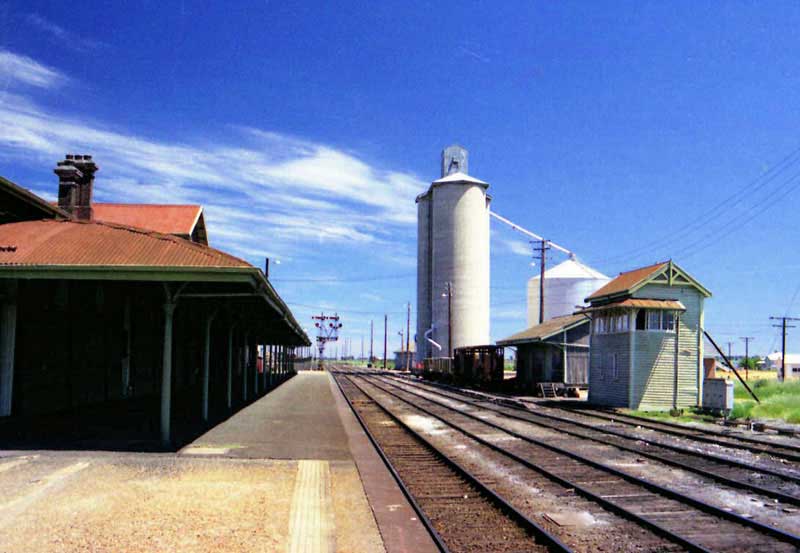
Australian Towns and Their Railway Stations
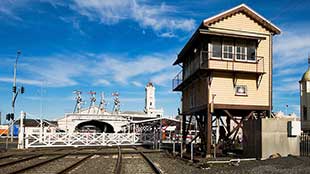
The Signal Box
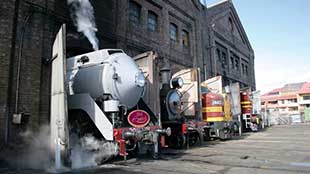
The Railway Workshops
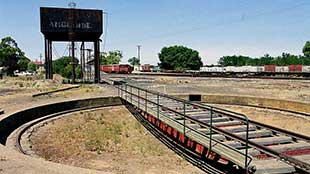
The Railway Yard and Siding
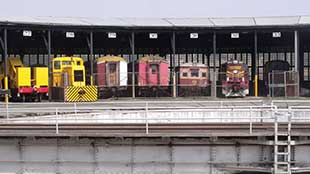
The Roundhouse
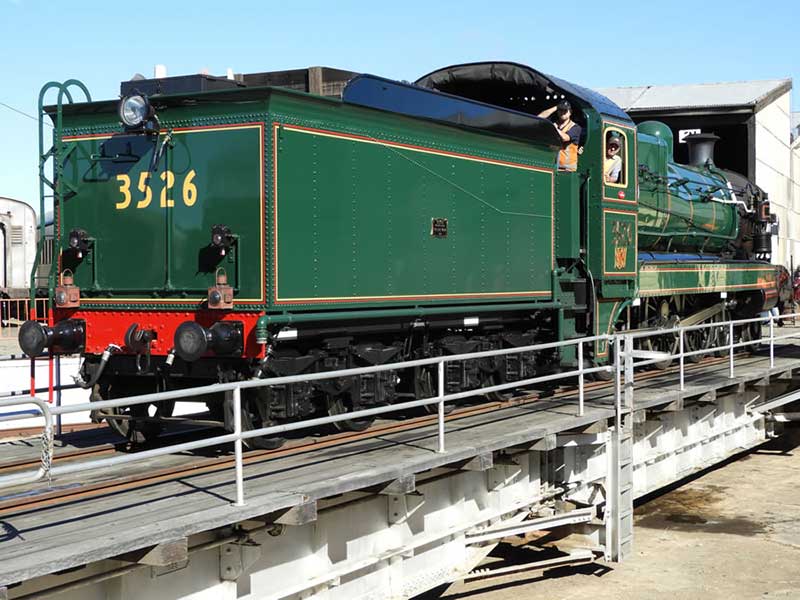
The Turntable
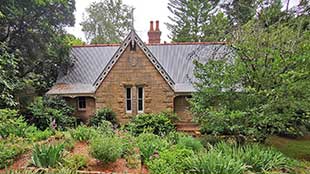
The Workers' Accommodation